

Water, Biomethane and a New Agricultural Strategy: Key Topics at BLACK SEA GRAIN.KYIV-2026
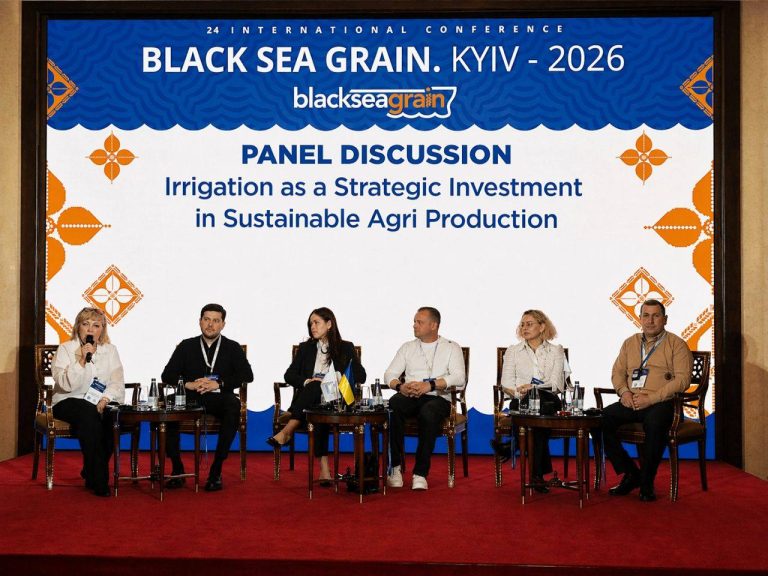
Ukraine’s agricultural sector is entering a period when simply growing grain is no longer enough. Climate change, water scarcity, rising electricity costs, and increasing global competition are forcing businesses to search for new survival models. These were the key topics discussed at the international agricultural conference BLACK SEA GRAIN.KYIV-2026, held this year under the slogan UA Agro Restart: Future Strategies 2026–2030.
The conference’s central discussion essentially focused on one question: what will Ukrainian agriculture look like in five to ten years — and is the country ready for the new realities?
While just a few years ago the main topics of the agricultural market were yields and logistics, discussions now also include water, energy independence, processing, and even biomethane.
Water Is Becoming Scarcer While Demand Continues to Grow
One of the conference’s central themes was irrigation reform and the development of water management systems. The reason is simple: farmers are increasingly feeling the effects of climate change.
Droughts, moisture shortages, and crop risks are no longer problems limited to southern regions. Ukraine is gradually entering a new reality where water is becoming one of the key factors for agricultural stability.
During the panel discussion, Deputy Minister of Economy, Environment and Agriculture Iryna Ovcharenko stated directly that irrigation is no longer just a way to improve yields, but a matter of strategic security for agricultural production.
According to her, Ukraine has been undergoing a complete transformation of its water resource management system since 2021. The government is changing legislation, creating new management mechanisms, and transferring some authority directly to farmers.
Currently, 77 water user organizations have already been established in Ukraine, with 14 of them receiving irrigation infrastructure for management and operation.
“We are effectively carrying out a full transformation of the irrigation system by involving farmers in infrastructure management,” Ovcharenko said.
However, the main issue remains much deeper — the state still lacks a complete understanding of the country’s actual water resources.
Although Ukraine has a water cadastre and water consumption balance systems, they still do not provide a clear picture of where there is sufficient potential for large-scale irrigation development.
That is why one of the priorities should become the creation of a modern public map of water resources.
In practice, this means the agricultural sector is gradually moving away from the principle of “watering wherever we want” toward a much stricter logic: water is becoming a resource that must be managed with extreme precision.
The Most Expensive Part of Water Is Not the Water Itself
A separate discussion focused on irrigation costs. According to Iryna Ovcharenko, up to 80% of water costs today are generated by electricity prices. This creates a new challenge for farmers: even if water is physically available, delivering it is becoming increasingly expensive.
As a result, the sector is already searching for new technological solutions — from irrigation modernization to energy-independent water supply models.
This is where the topic of water unexpectedly intersected with another major conference theme — bioenergy.
Biomethane: A New Agricultural “Blue Ocean”
During the panel Food, Fuel, Future: How Will Ukraine Scale Processing?, participants discussed not only grain or yields, but also the future model of Ukraine’s economy.
UABIO Chairman Heorhii Helietukha described biomethane as one of Ukraine’s most promising sectors. The reason lies in Europe’s global transition toward decarbonization. By 2050, the EU plans to largely replace natural gas with renewable energy sources, making biomethane a key resource.
“Biomethane is a complete substitute for natural gas,” Helietukha emphasized.
Today, Europe produces only about 5 billion cubic meters of biomethane annually, although it aims to increase production to 35 billion cubic meters by 2030.
According to experts, this creates a huge opportunity window for Ukraine.
A large agricultural sector, substantial raw material volumes, and large-scale farming operations give Ukraine the potential to build major biomethane plants that could become more competitive than European facilities.
“The European market would gladly absorb these volumes,” Helietukha said.
At the same time, he admitted that the full-scale war effectively put the development of this sector on pause just as it was beginning to emerge.
Processing Is No Longer a Trend — It Is a Necessity
Another major conference topic was agricultural processing.
For many years, Ukraine’s agricultural sector operated under a raw commodity export model. However, businesses are now increasingly discussing the need to produce higher value-added products — from bioethanol to biomethane and deep agricultural processing.
At the same time, market participants warned that chaotic construction of processing facilities without understanding future sales markets could lead to serious problems.
Hals Agro CEO Serhii Kravchuk compared the situation to a “blue ocean” — a market with enormous potential but also significant risks.
“Creating new production capacities without securing sales channels in advance leads to disaster,” he stressed.
According to him, Ukraine is already seeing similar issues in the sugar industry, while a comparable scenario could emerge in rapeseed oil or bioethanol production.
Therefore, the conference’s main conclusion sounded highly pragmatic: the future of Ukraine’s agricultural sector lies not simply in increasing production, but in maintaining a precise balance between water, energy, processing, and sales markets.
And it appears that in the coming years, the struggle for this balance will determine who can survive in the new agricultural market.
Read also
Ukrainian farmers may reduce pea planting due to low prices and high logistics costs
Ukrainian farmers expand commercial pumpkin production
US soybean crush falls to 13-month low
Global wheat supply deficit triples, increasing upside price risks
India to involve 40,000 farmers in mustard yield improvement program




Got additional questions?
We will be happy to assist!
Write to us
Our manager will contact you soon