

Which EU regions rely heavily on agriculture?

In 2020, approximately 4.5% of the EU’s total employment, an estimated 9.4 million people, worked within the agriculture, forestry, and fishing sector. The vast majority, or 4.2% of total employment, worked in agriculture, according to a report from Eurostat.
The agriculture, forestry and fishing sector continues to be a significant source of employment, particularly in eastern and southern EU countries. Looking at the NUTS 3 regional data, Romania’s Vaslui (61.7%) and Neamţ (51.4%) regions reported the highest employment rates in this sector. Furthermore, 114 regions had over 16.5% of their workforce employed in agriculture, forestry, and fishing, with concentrations in Bulgaria, Greece, Poland, Portugal and Romania.
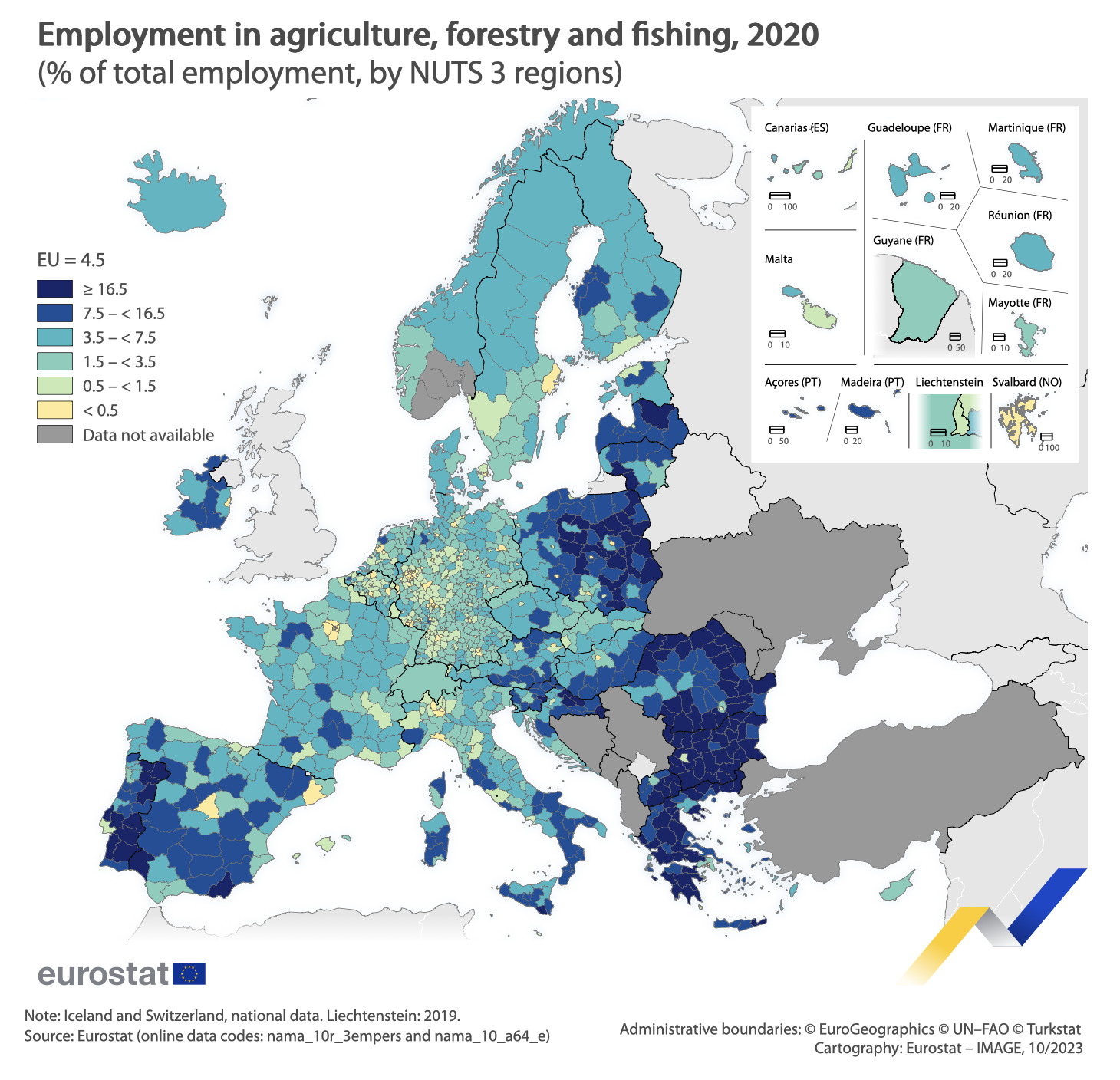
Toward the lower end of the range, 137 regions in 2020 had less than 0.5% of their workforce employed in agriculture, forestry, and fishing.
In absolute numbers, the regions with the highest employment in agriculture, forestry, and fishing were predominantly located in Romania, with 8 out of the top 10 regions. The region of Iaşi in Romania had the highest count at 146 200 employees, followed by four other Romanian regions with over 100 000 employees each. Apart from the Romanian regions, only two other regions made it into the top 10 NUTS 3 regions with the highest employment figures in agriculture, forestry, and fishing: Sandomiersko jędrzejowski in southeast Poland and Almería in southern Spain.
Read also
Romania proposes joint NATO command to protect the Black Sea
Drought in India threatens sugar and biofuel production
Record sunseed harvest in Russia threatens to drive down prices in Kazakhstan
Corn drying costs in Ukraine could exceed the value of the grain at current prices
Oilseeds remain the only profitable segment of crop production in Russia




Got additional questions?
We will be happy to assist!
Write to us
Our manager will contact you soon