

Ukraine determines the origin of grain stolen by Russia with nearly 100% accuracy
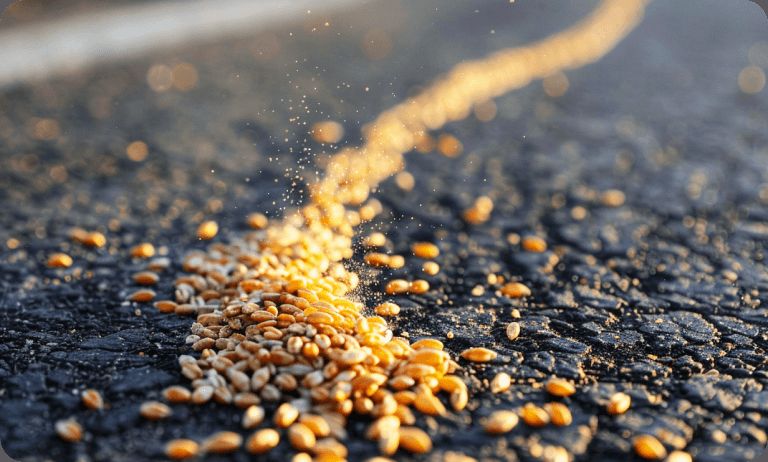
Ukraine, together with the United Kingdom and Lithuania, has developed a system that allows identifying the origin of grain from temporarily occupied territories using unique markers. This was stated by Taras Vysotskyi, Deputy Minister of Economy, Environment and Agriculture of Ukraine, in an interview with DW.
According to him, the first pilot projects began in 2024.
“The essence is as follows: we have grain samples from Ukrainian territories that are currently temporarily occupied. These samples are stored at a state-owned enterprise — essentially a seed bank. Each sample has unique markers related to climate, weather, soil, and other characteristics of the place of cultivation. Based on these markers, a database has been developed that allows us, with a probability close to 100%, to determine whether a given grain originates from specific territories,” Vysotskyi explained.
The methodology and equipment for the project were provided by the United Kingdom, while the testing laboratory is located in Lithuania, which also has port infrastructure allowing the tracking of grain movements, including its possible origin from occupied regions of Ukraine.
According to Vysotskyi, all that is needed for analysis is a sample. The technology is highly accurate and can identify Ukrainian grain even if Russians mix it with their own.
“If you mix it 50/50, it will definitely detect it. If 5% is from occupied territories and 95% from elsewhere, the probability of detection decreases. But there is no economic benefit in such mixing — it is too labor-intensive. Practice shows that if the admixture exceeds 10%, the technology detects it. It is very difficult to bypass it through blending while maintaining economic efficiency. But a sample still has to be taken,” he said.
In addition to laboratory analysis, Ukraine also uses satellite data to track the origin of grain. In particular, loading vessels in the ports of Crimea, Berdiansk, or Mariupol may indicate that the goods originate from occupied territories. Accordingly, official sampling later allows verification.
At present, there are not many requests for such laboratory studies, as each case is highly sensitive, Vysotskyi added. All cases are later made public, and the Office of the Prosecutor General is among the cooperating parties. Depending on the situation, the initiator may be either the state or an independent arbitration certification body at the request of an embassy in a given country.
“If we talk about the total number over the entire period, it is several dozen, not hundreds. Over the last year, significantly fewer. It seems they continue to steal grain, but act more cautiously. In the early years of the full-scale invasion, exports were more open, but at that time we did not yet have these laboratory capabilities for factual confirmation,” he noted.
He also said that Israel has confirmed its readiness to cooperate in the case involving vessels with allegedly stolen Ukrainian grain, although details of the process have not yet been disclosed.
According to Ukraine’s estimates, around 8–10 million tons of crops are harvested annually in the temporarily occupied territories, mainly wheat and sunflower. In total, about 30 million tons of grain and oilseed crops were harvested in the occupied lands during the first three years of the war. Including the current season, up to 50 million tons of agricultural products may have been stolen.
Vysotskyi emphasized that these estimates are part of the evidentiary basis for the large-scale and systematic appropriation of Ukrainian resources.
For almost 30 years of expertise in the agri markets, UkrAgroConsult has accumulated an extensive database, which became the basis of the platform AgriSupp.
It is a multi-functional online platform with market intelligence for grains and oilseeds that enables to get access to daily operational information on the Black Sea & Danube markets, analytical reports, historical data.
You are welcome to get a 7-day free demo access!!!
Read also
Romania proposes joint NATO command to protect the Black Sea
Drought in India threatens sugar and biofuel production
Record sunseed harvest in Russia threatens to drive down prices in Kazakhstan
Corn drying costs in Ukraine could exceed the value of the grain at current prices
Oilseeds remain the only profitable segment of crop production in Russia




Got additional questions?
We will be happy to assist!
Write to us
Our manager will contact you soon