

Crop prices hit a three-year high amid heat and Black Sea escalation

Crop prices climbed to their highest level in three years as heat waves and escalating attacks in the Black Sea threatened to disrupt global grain trade, reviving concerns over food inflation that have also been fueled by the conflict between the United States and Iran.
The Bloomberg Agriculture Spot Index, which tracks ten major agricultural commodities, reached its highest level since July 2023 on Wednesday, extending gains for a seventh consecutive week. The index previously peaked in May when the conflict involving Iran disrupted fertilizer and fuel shipments, although that geopolitical risk premium eased the following month. Fresh military and weather-related risks have now pushed agricultural markets higher once again.
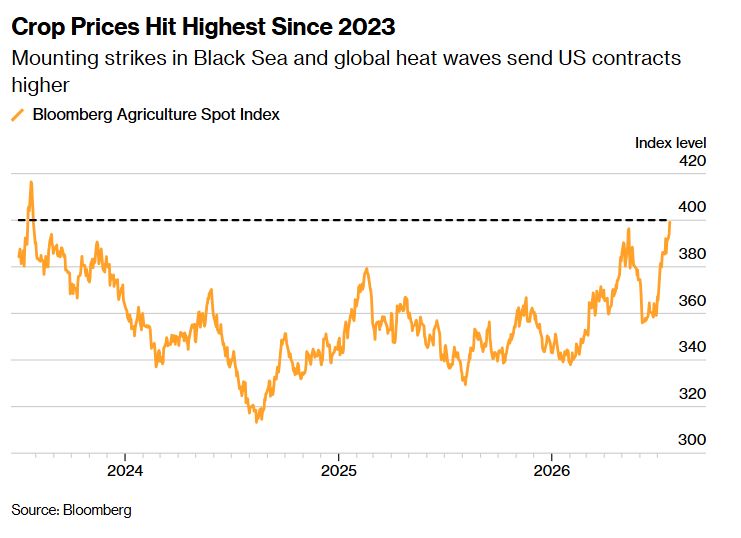
Energy markets have also rallied as tensions in the Middle East intensify, while Europe’s grain harvest is being damaged by severe heat. At the same time, wheat prices continue to rise as Russia and Ukraine step up attacks on each other’s export corridors, disrupting grain shipments at the height of the harvest season.
If the rally continues, it could spread throughout the food supply chain, increasing the cost of staple products ranging from bread and vegetable oils to meat and dairy products. Although global grain inventories remain relatively comfortable after several years of strong harvests, the return of the El Niño weather pattern has added further concerns over future crop production, with coffee and cocoa futures also climbing in July.
“Up to now, the market had been relying on uninterrupted grain shipments despite the war in Ukraine,” said Mike Verdin, Senior Markets Consultant at CRM AgriCommodities. According to him, the latest disruptions effectively represent “a reopening of the original wound caused by Russia’s invasion.”
Verdin noted that the key question is not only how much grain Russia and Ukraine will actually be able to export, but also how importers perceive the reliability of those supplies.
“Many importers would rather pay a premium for reliable supplies, adding further pressure to food inflation,” he said.
Chicago wheat futures extended their rally on Thursday, reaching the highest level in two years after surging more than 4% in the previous session amid escalating attacks by Russia and Ukraine on ports and commercial vessels. Together, the two countries account for more than one-quarter of global wheat exports.
Russian forces continued strikes on Odesa, damaging port infrastructure. At the same time, the Russian oil and grain export hub of Novorossiysk has reportedly introduced an informal nighttime navigation ban as Ukrainian drone attacks intensify. In addition, vessels have been prohibited from anchoring in parts of the Sea of Azov and at the Port of Kavkaz where organized air defense systems are unavailable.
The renewed conflict between the United States and Iran has also pushed crude oil prices to their highest level in weeks, increasing demand for biofuel feedstocks such as corn and vegetable oils.
Chicago soybean futures also climbed to a two-year high on Thursday, while palm oil futures in Kuala Lumpur rose by as much as 2.1%. Palm oil has recently returned to trading at a discount to gasoil, making it more attractive for biofuel production.
Meanwhile, extreme heat across Europe is adding to concerns over crop losses, particularly for corn. France, the European Union’s largest agricultural producer, has experienced three heat waves since late May, with record-breaking temperatures putting severe stress on grain crops during a critical stage of development.
“Taken together, these factors are lifting prices across virtually the entire crop sector,” said Vitor Pistoia, Senior Grains and Oilseeds Analyst at Rabobank.
Corn and soybean fields in the United States have also been challenged by a period of hot and dry weather. One options trader placed a $20 million bet on Wednesday that corn prices could rise to $6 per bushel, more than $1 above current levels.
Although US soybean crop conditions have recently improved, stronger export sales to China have provided additional support to the market.
In the soft commodities sector, the return of El Niño has also driven arabica coffee and cocoa prices higher. Both markets are on track for monthly gains in New York, as the weather phenomenon could bring unusually hot and dry conditions to West Africa, one of the world’s most important cocoa-producing regions.
Read also
EU risks becoming dependent on China amid aviation fuel feedstock shortages
Ukraine to compensate shipowners for up to 80% of losses from Russian attacks
Soybean cultivation in Europe shifts north due to drought
Global beef production to decline by more than 3% for the first time in five years
Indonesia launches new palm oil export monitoring system




Got additional questions?
We will be happy to assist!
Write to us
Our manager will contact you soon