

Crop and fertilizer markets wipe out Iran war risk premium

The risk premium associated with the conflict involving Iran is rapidly fading from global crop and fertilizer markets as concerns over prolonged supply disruptions ease, reducing one of the key threats to food inflation.
Prices of urea, one of the world’s most important crop nutrients, have plunged by more than 30% since mid-April, erasing all gains triggered by the conflict. The decline has weighed on corn, wheat, and other agricultural commodities, while the Bloomberg Agriculture Spot Index, which tracks ten of the world’s most actively traded crops, fell to its lowest level since March 5 last Friday.
The situation marks a dramatic reversal from the early weeks of the conflict, when the effective closure of the Strait of Hormuz disrupted roughly one-third of globally traded urea supplies. Prices surged, forcing farmers to search for alternative sources. The recent decline in fertilizer prices could help lower production costs and slow food inflation, although experts warn that energy prices remain elevated and fertilizer markets are still vulnerable to renewed tensions in the Middle East.
“What we’re seeing is the market unwinding the risk premium,” said Kang Wei Cheang, an agricultural broker at StoneX in Singapore. However, he cautioned that the market has not yet fully recovered from the initial shock, which was both significant and real.
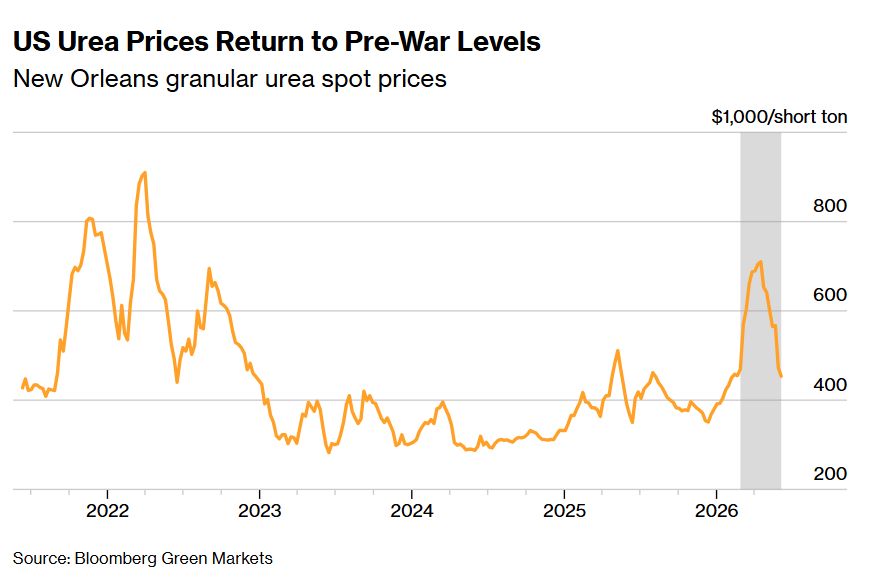
The sharp drop in urea prices, the world’s most widely used nitrogen fertilizer, followed China’s decision to ease export restrictions and the market’s adjustment to supplies that had been stranded around the Strait of Hormuz. Weak grain prices have also reduced demand from farmers, while several South Asian producers resumed operations after cutting output during the early stages of the conflict.
Seasonal factors have also contributed to the correction. Planting activities have largely concluded across much of the Northern Hemisphere, while Brazil postponed purchases and reduced imports compared with a year earlier. As concerns about Middle Eastern supply disruptions eased, buyers became less worried about immediate shortages.
“The fertilizer market has undergone a remarkable shift over the past month. The conversation has changed from how high prices can go to how much further they might fall,” said Andrew Whitelaw, founder of agricultural market analysis firm Episode 3.
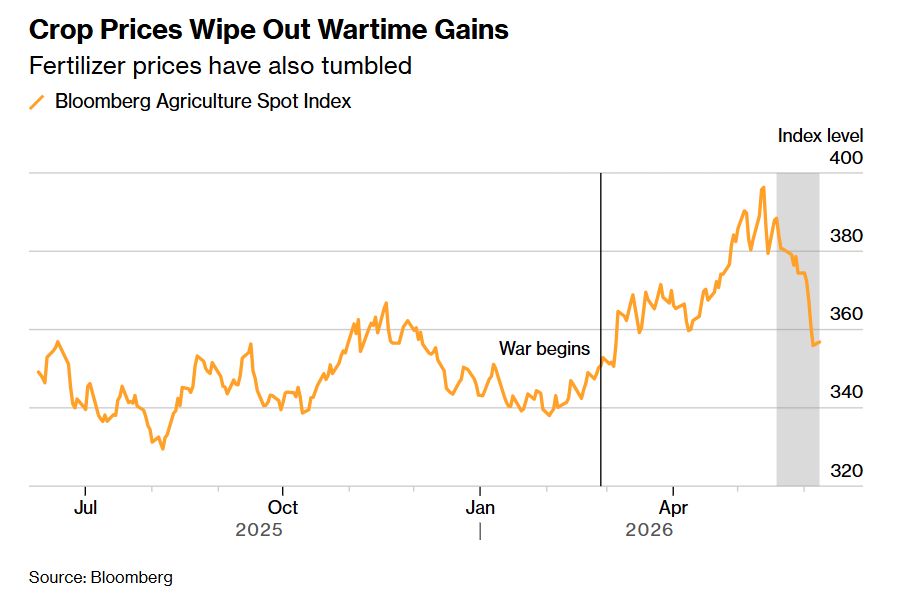
Crop markets have also experienced a notable turnaround. The Bloomberg Agriculture Spot Index has declined about 10% from its mid-May peak and is approaching levels seen before the conflict, when abundant harvests and large global inventories weighed on agricultural commodity prices.
Favorable crop conditions in the United States and the start of harvests across the Northern Hemisphere have boosted global grain supplies, putting further downward pressure on prices. According to Kpler lead agricultural commodities analyst Ishan Bhanu, global stockpiles remain ample and current supply-demand balances are not a cause for concern.
Nevertheless, analysts warn that markets remain highly sensitive to geopolitical developments. Any renewed disruption to energy supplies or escalation of tensions in the Middle East could once again drive prices higher. Brazil is expected to play a crucial role in determining urea market trends during the second half of the year.
Analysts expect fertilizer demand to strengthen from July onward, which could support prices. However, many believe that urea prices have already reached their peak for 2026.
Market participants will also closely watch fertilizer prices at the farm level later this summer and into the fall, when growers begin securing supplies for next year’s crops. If a peace agreement is reached and a ceasefire holds, prices could stabilize. However, inflationary risks and significant uncertainty remain.
“The market correction is good news, but it should not be treated as the end of the story. The conflict continues to create inflationary pressures, and a great deal of uncertainty remains,” said David Ortega, professor of food economics at Michigan State University.
For almost 30 years of expertise in the agri markets, UkrAgroConsult has accumulated an extensive database, which became the basis of the platform AgriSupp.
It is a multi-functional online platform with market intelligence for grains and oilseeds that enables to get access to daily operational information on the Black Sea & Danube markets, analytical reports, historical data.
You are welcome to get a 7-day free demo access!!!
Read also
Soybean harvesting nears completion in Ukraine, with production exceeding 3 mln tons
Palm oil prices in Malaysia rise to four-week high
Cambodia exports over 1 mln tons of rice for the first time as shipments to the Ph...
China loses share of Argentine beef exports as US and Israel increase purchases
Global sugar market faces deficit of over 6 mln tons due to poor harvests




Got additional questions?
We will be happy to assist!
Write to us
Our manager will contact you soon