

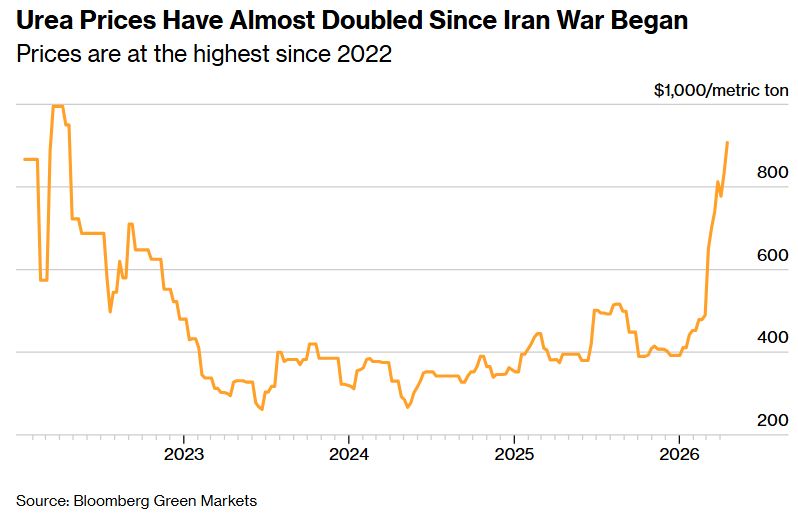
Nitrogen fertilizer prices have doubled since the start of the Gulf War

The military action effectively blocked the Strait of Hormuz, cutting off about a third of the seaborne transport of fertilizers. This has raised serious concerns about a possible food crisis, and countries have begun to look for alternative sources of supply for the agricultural sector.
Fertiglobe has already seen a decline in purchases in regions such as sub-Saharan Africa and Australia. Brazil has also been vulnerable to fertilizer shortages and uncertainty in demand, especially in the face of rising prices.
El-Hoshi noted that nitrogen fertilizer prices are already well above pre-crisis levels and that further increases are possible due to the blockade in the Persian Gulf. He stressed that this creates difficult conditions for farmers, which could lead to an increase in the cost of grain and food.
The blockade of the Strait of Hormuz has significantly affected the seaborne transport of fertilizers, increasing concerns about a food crisis. In response, countries have begun to look for alternative supply routes for farmers. However, some major producers have restricted exports, leading to additional costs for buyers.
On Friday, Iran announced the resumption of shipping through the strait, but less than a day later, the movement of ships was abruptly halted due to escalating tensions. The conflict, which has been going on for eight weeks, has caused disagreements between the United States and Iran over the next steps, increasing uncertainty about possible peace talks.
Particularly acute is the problem of shortages of nitrogen fertilizers, such as urea and ammonia, which are needed annually to maintain yields. In contrast, phosphate and potassium fertilizers can be stored in the soil, allowing farmers to temporarily forgo their application.
Al-Khoshi, citing Fertiglobe data, said that urea exports from the Persian Gulf fell to 300,000 tons in March from the usual 1.7 million tons, mainly from Oman.
Agricultural prices have yet to keep pace with the sharp rise in fertilizer and fuel prices, making it difficult for farmers to offset the increased costs. This contrasts with 2022, when the conflict in Ukraine caused grain prices to rise, reflecting both countries’ roles as major agricultural producers.
Al-Hoshi noted that once the Strait of Hormuz reopens, it will take time for supplies to recover and the deficit to narrow. He also said that ships are currently in the strait being used as floating storage.
Fertiglobe is considering alternative routes for transporting its products, including land transport, although volumes will be lower than by sea. The company is in a better position due to the location of its facilities in Abu Dhabi, close to Oman and the port of Fujairah.
The company also has offices in Egypt and Algeria, allowing it to continue serving customers.
Read also
Moldovan farmers threaten protests over VAT increase on grains and oilseeds
US rail fuel surcharges pressure grain prices for farmers during harvest
France may harvest smallest corn crop in 50 years
Palm oil rises as crude oil prices climb
A reduction in sown area will bring soybean production in China down to 20.1 mln tons




Got additional questions?
We will be happy to assist!
Write to us
Our manager will contact you soon