

China develops robot for automated crop pollination with 92.8% recognition accuracy
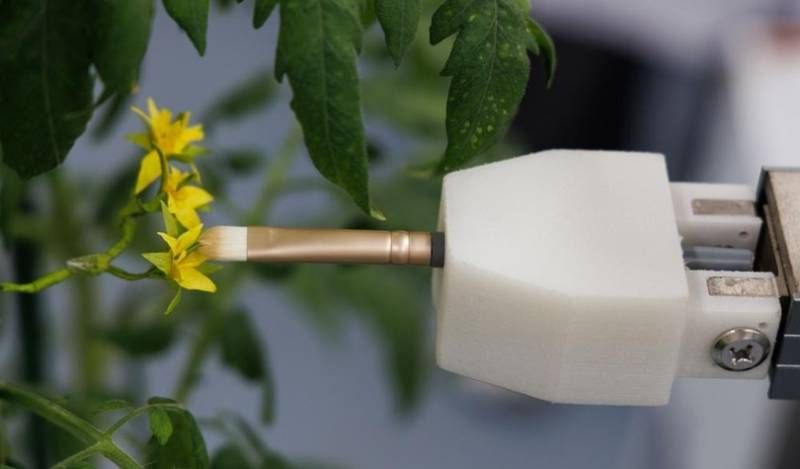
China has unveiled the GEAIR 2.0 humanoid robot designed to automate hybrid pollination in crop breeding. The system was developed by the Institute of Genetics and Developmental Biology under the Chinese Academy of Sciences and presented at the 33rd China Beijing Seed Industry Conference.
GEAIR 2.0 can autonomously identify flowers, move among plants and perform pollination without continuous operator supervision. In the upgraded version, stigma-recognition accuracy increased from 85% to 92.8%.
The robot now uses two arms instead of one, allowing it to navigate more effectively around leaves and branches. During a tomato demonstration, one hand held the pollen container while the other operated a pollination brush. Each pollination took less than 10 seconds, while a single dip of the brush into pollen was enough for around 50 pollinations.
The technology combines robotics, artificial intelligence and genome editing. Researchers develop plants with more exposed reproductive structures so the robot can identify and access them more easily. The approach was initially tested on tomatoes and was later extended to soybeans.
Developers believe automated hybrid pollination could reduce the need for manual labor, lower breeding costs and accelerate the development of new varieties and hybrids. In the future, such systems could be used in larger-scale breeding programs across different crops.
Read also
Hungary will not oppose transit of Ukrainian grain to Europe — Magyar
Coming Up in UkrAgroConsult Reports: Key Market Signals
Zelenskyy warns of continued Russian attacks on Black Sea ports
Canada’s new wheat crop quality exceeds expectations
Ukrainian farmers may reduce pea planting due to low prices and high logistics costs




Got additional questions?
We will be happy to assist!
Write to us
Our manager will contact you soon