

Grain Exports Under Pressure: Freight, War Insurance and the Danube Bottleneck
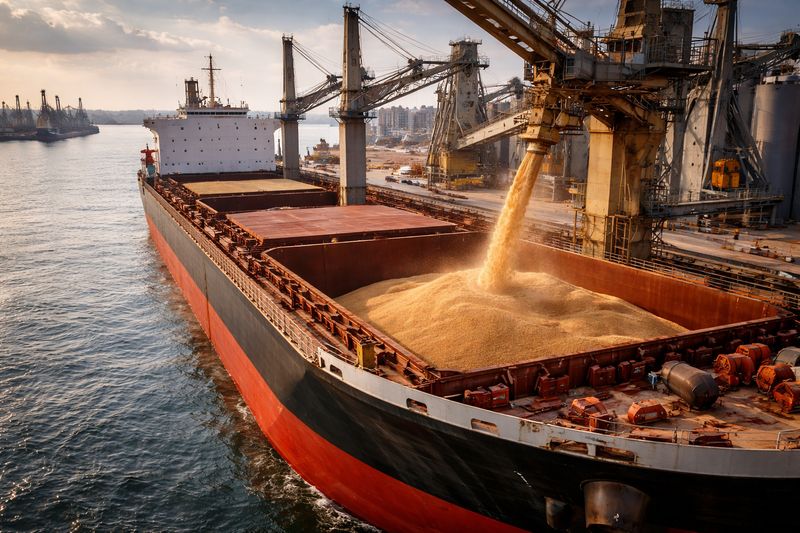
With Greater Odesa’s deepwater ports effectively disrupted, Ukraine’s agricultural logistics are increasingly dependent on the Danube and transit through neighbouring countries. Stronger activity on alternative routes helped support the recovery in exports in September, but it did not close the capacity gap between major seaports and smaller river terminals. The composition of transport flows has shifted over the year: Greater Odesa’s contribution has contracted while Danube shipments, rail and road transport have become more important in maintaining trade flows.
According to UkrAgroConsult, agricultural exports increased to 2.17 mln tones in September, with shipments through the Danube ports approaching 1 mln tones. Romania’s Constanța also strengthened its role as a transit hub for Ukrainian grain. This redirection demonstrates exporters’ ability to adapt to constrained routes, while making shipments increasingly reliant on infrastructure, regulatory decisions and vessel availability outside Ukraine.
Shipping security is becoming the central source of uncertainty across the western Black Sea. Reported attacks on commercial vessels near Romania and Bulgaria are changing risk assessments not only for Ukrainian ports but for the wider region. This affects shipowners’ willingness to accept voyages, war-risk insurance premiums and delivered costs. Coaster freight from Reni and Izmail to Alexandria reached $48–58/mt in October, alongside sharply higher insurance costs; services from Constanța and Bulgarian ports remain comparatively cheaper, although they have also become more expensive.
Congestion in the Sulina Canal adds another layer of costs, as queues, delays and vessel demurrage increase the logistics bill even without further increases in base freight rates. The comparison of shipping routes underscores that export economics depend on the combined effect of freight, insurance, security exposure and waiting time. Should Romania restrict navigation through Sulina, the Bystre mouth and upstream barge movements with transshipment at Romanian ports could offer partial relief, but limited fleet availability, throughput and terminal infrastructure mean they cannot rapidly replace the main route.
The consequences of disrupted logistics may become most acute as the new corn crop reaches the market. Higher transport costs and uncertain shipment schedules reduce the price exporters can pay for grain inland, squeeze farm margins and raise the risk of stock accumulation and storage shortages. UkrAgroConsult assesses that the resilience of Ukraine’s grain exports will increasingly depend on secure Danube access, efficient queue management, workable alternatives and the willingness of international carriers and insurers to operate in the region.
Key trends
- Ukraine’s shift towards Danube ports and Romanian transit infrastructure is helping sustain agricultural shipments, but these routes cannot fully offset restrictions at Greater Odesa’s deepwater ports.
- Expanding threats across the western Black Sea are making maritime security a region-wide determinant of vessel availability, freight rates and war-risk insurance premiums.
- Higher freight, insurance and Sulina Canal waiting costs are weakening the price competitiveness of Ukrainian grain and putting additional pressure on export margins.
- Alternative Danube routes offer some diversification, but limited navigational capacity, barge availability and transshipment infrastructure prevent a rapid replacement of Sulina.
- During the new corn marketing peak, logistics disruptions could accelerate domestic stock accumulation, tighten storage availability and transmit further price pressure to Ukrainian farmers.
Would you like to receive the full analytical report with all insights and data? Please complete the form to gain access to the material. The full version will be sent to your email.
Full version of the article is available to subscribers ‘BLACK SEA & DANUBE GRAIN REPORT’ and ‘BLACK SEA & DANUBE OILSEED REPORT’. You may request a sample report and apply for subscription. Be confident with your business strategy based on professional analysis and forecasts of the Black Sea & Danube agri market!
Read also
Wheat market gradually becomes less responsive to Black Sea export disruptions
4S Business Summit: Join Delegates From 10+ Countries!
Japan resumes imports of Ukrainian poultry meat and eggs after five-year ban
Security risks and Sulina Canal closures complicate shipments from Danube ports
China expects bumper grain harvest, adding pressure on corn prices




Got additional questions?
We will be happy to assist!
Write to us
Our manager will contact you soon