

From EU to Central Asia – Where Can the First Alternative Logistics Corridor Be Formed Together?
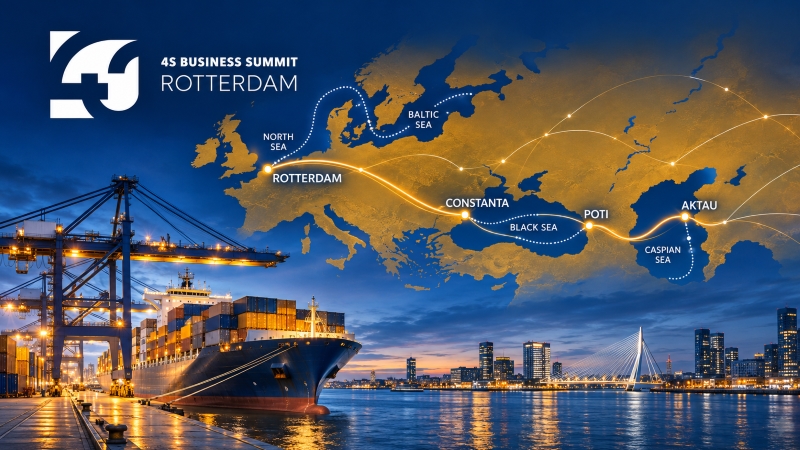
A line on a map is not yet a trade route. This was the key message delivered by Arnaud Burgess, Panteia, Netherlands at the 4S Business Summit Rotterdam on 4 November 2026. The Summit was organized by UkrAgroConsult and Innovation Media.
Arnaud Burgess’s presentation focused on the logistics of critical minerals from Central Asia, but its conclusions are equally relevant to grains and oilseeds.
European demand for alternative logistics corridors and supply chains is increasing. This includes growing demand for domestic processing capacity for both mineral and agricultural raw materials. China controls around 92% of global rare-earth refining capacity and 92% of battery-grade graphite production (source: Panteia, citing the IEA).
This explains why the EU is looking east through the Caspian Sea, the Caucasus and Türkiye, and why it is paying particular attention to the development of the Middle Corridor. The Middle Corridor involves at least seven transshipments, 4,256 km of railway and a 508 km crossing of the Caspian Sea. Today, the corridor handles only around 3.3 M mt of cargo annually. Panteia analysts expect its capacity to increase to approximately 11 M mt by 2030.
However, this scenario requires substantial infrastructure investment and better corridor management. According to the EBRD, the required investment totals €18.5 Bn, of which around €10 Bn could be provided through the EU Global Gateway programme.
The real product offered by this logistics corridor is reliability. Expansion of the Middle Corridor railway network has already started. However, on the Rhine–Danube rail route, only 31% of monitored trains reached their final destination within 30 minutes of schedule in 2025, compared with 42% in 2024. Only 29% of the route complies with the 740-metre train-length standard, according to the draft corridor work plan. Panteia analysts recommend planning delivery periods using a wider transit-time range, such as P90, instead of relying on the shortest but largely theoretical transit time.
The same trends are emerging across the Danube and Balkan region. At the Rail Freight Corridor meeting in Budapest on 13 October 2026, participants warned that repair works on Serbian and Romanian–Bulgarian routes could cause disruptions in 2027. Diversions through Giurgiu–Ruse, Calafat–Vidin and Negru Vodă–Kardam may require diesel traction, additional locomotives or lighter train formations.
As another logistics option, Akdoğan Train Cargo plans to launch an intermodal Türkiye–Europe service in January 2028.
In April 2026, market participants in Constanța confirmed to Panteia analysts that grain flows remain strongly seasonal, rail access to the port needs to be expanded and road transport continues to dominate grain deliveries. Congestion regularly develops during the harvest season. Danube operators are primarily concerned about the reliability of navigable water levels.
Panteia’s presentation proposed stronger coordination between the ports of Rotterdam and Constanța, with the long-term objective of creating a single transport chain. Constanța could serve as an entry point for cargo, while Rotterdam could operate as a processing and rolling-stock recycling cluster. Panteia emphasised that this remains a proposal rather than a confirmed project.
UkrAgroConsult analysts are also closely monitoring logistics developments across the Black Sea–Danube–Balkan region.
Key regional logistics trends:
- Logistics reliability is now more important than transport speed. Investment is moving towards corridors that can provide predictable and dependable delivery.
- Border crossings, ports and rail-gauge interchange points require urgent improvement. Delays increase demurrage, storage and financing costs.
- Backhaul cargo determines whether a transport service can be commercially sustainable.
Sources: Panteia, Connecting Continents, Shaping Policy, policy brief for the Netherlands Ministry of Infrastructure and Water Management, February 2026; RFC Rhine–Danube RAG-TAG, Budapest, 13 October 2026; draft Rhine–Danube Corridor Work Plan, 27 March 2026; Romanian National Transport Model and interviews in Constanța, 8–9 April 2026; IEA Global Critical Minerals Outlook 2025; World Bank volume data cited in the presentation; UkrAgroConsult market research and reports.
Read also
Indonesia and Malaysia are nearing the limits of oil palm plantation expansion
Egypt becomes EU’s largest apple export market, overtaking the UK
Declining wheat stocks among Chinese farmers limit further price declines
US soybean crush rises 19% month-on-month to a new record
Black Sea risks becoming another Strait of Hormuz for global grain trade




Got additional questions?
We will be happy to assist!
Write to us
Our manager will contact you soon