


Expansion of military activity in the Black Sea threatens grain logistics. What will happen to exports?
Article author:
What is happening? In the first two weeks of July, Russia carried out 23 strikes on Ukrainian seaports and 17 attacks on civilian vessels, as a result of which vessel calls to the ports of Greater Odessa have nearly stopped, while marine terminals are suspending grain intake. Russia, in turn, has restricted navigation in the Sea of Azov amid a Ukrainian operation aimed at reducing the aggressor’s oil revenues.
The current situation is quite critical for Ukraine, as recently around 90% of agricultural exports have been shipped through deep-water ports, which have become the target of Russian attacks. The suspension of seaborne exports has led to a reduction in port procurement and a redirection of cargoes to the western border and river ports. At the same time, it is worth noting that alternative routes remain an emergency export option. Back in 2023, around 2 mln t of grain per month was exported through small Danube ports, while another 1 mln t was shipped by rail and road transport. Therefore, even in the worst-case scenario for Odessa ports, a complete halt of Ukrainian exports is not expected.
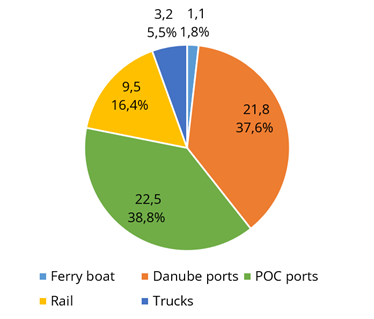
Distribution of agricultural exports by export channel in 2023, mln t
As for Russia, exports via the Sea of Azov accounted for around 30% of wheat exports, while deep-water ports are still operating normally. Therefore, weaker export pace can be expected in July–August: due to navigation restrictions in the Sea of Azov and a slower harvest campaign, shipments may be around 3 mln t lower than in the same period last year, when Russia exported around 3 mln t of wheat in July and 5 mln t in August. At the same time, domestic fuel price growth is increasing costs across the entire logistics chain, while grain procurement prices continue to decline.
How long will this last? The more likely scenario is a temporary pause or reduction in export flows of Ukraine’s new-crop wheat, barley and rapeseed over the next one to two months. Potentially, during this period Ukraine was expected to export around 3 mln t of wheat and up to 1 mln t of barley and rapeseed.
A rapid resolution of the situation would only be possible if there is political will from the international community — similar to what happened in 2022 with the UN-backed Grain Corridor. Further developments will depend on the intensity of Russian attacks, shipowners’ sentiment and the degree of degradation of marine terminal infrastructure caused by the strikes.
What about freight? The current situation is reducing demand for coaster shipments in Russia and could potentially limit demand for Handysize and Panamax vessels in Ukraine — primarily in a scenario where deep-water ports stop operating. The freight market is already reacting accordingly: some shipowners are refusing to call at Ukrainian ports. At the same time, from our side, we still see vessels at anchorage, so trade could resume if the attacks stop.
Insurers have updated the war-risk coverage rate for cargoes in Ukrainian waters to 1% with a 50% no-claim bonus, while war-risk insurance for vessels themselves remains at 1% and above. This indicates that a high risk premium remains in place for vessel calls to Ukrainian ports, primarily the ports of Greater Odessa, amid attacks on port infrastructure and vessels.
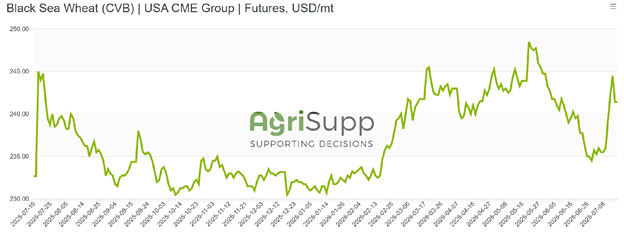
Who will benefit? The first to take advantage of this temporary vacuum could be neighboring Black Sea countries — Bulgaria and Romania. Over the past week, FOB prices for both wheat and barley have increased by 5 USD/t. In the longer term, the shortage of grain from the Black Sea region could be partially covered by other exporters from Europe and South America. The most extreme scenario for global prices would be one in which a prolonged blockade of Black Sea logistics is combined with continued tensions in the Middle East and the impact of a super El Niño in the Southern Hemisphere.
This article is also available to subscribers of ‘BLACK SEA & DANUBE GRAIN’ Weekly Report by UkrAgroConsult.
Request a free a sample report and apply for subscription here.
Be confident with your business and trade strategy based on professional analysis and forecasts of the Black Sea agri market.
Read also
Saudi Arabia consolidates grain business to strengthen food security
Palm oil prices fall despite sharp rise in Malaysian exports
Ukraine plans to prioritize edible oil exports over grain amid logistics constraints
Brazil more than doubles apple exports to Europe following harvest recovery
Two tankers catch fire near Sulina Canal in Romania amid drone attacks




Got additional questions?
We will be happy to assist!
Write to us
Our manager will contact you soon