

EU opens door to talks with Ukraine on next membership steps
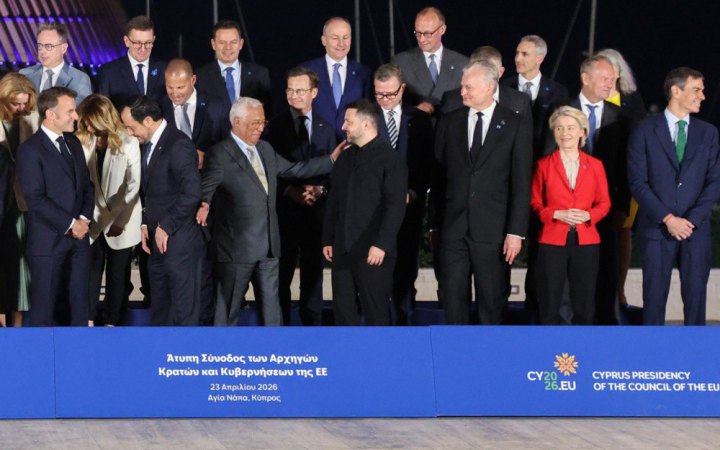
European Union leaders signaled that preliminary conditions are in place for Ukraine to begin the first stage of the membership process, a boost for Ukrainian President Volodymyr Zelenskiy’s efforts to join the bloc.
At a summit in Cyprus Thursday, leaders agreed the first accession negotiations could start in the coming weeks and months, according to an EU official, who spoke on the condition of anonymity.
But any commitment on a date for Ukraine to join the EU remains elusive. The membership process for Croatia, the last country to join, took about a decade.
Thursday’s discussion took place amid a fresh push by Ukraine to join the bloc after Hungary lifted its veto on a long-stalled €90 billion ($105 billion) loan to the country.
Earlier, Zelenskiy said that his country deserved “full-fledged” membership, rejecting proposals for an alternative path to the EU that’s faster but with fewer rights. It follows a push by France and Germany ahead of the summit for an “associate membership” option for Ukraine.
“Ukraine does not need symbolic membership in the EU,” Zelenskiy said in remarks provided by his office before arriving in Cyprus for the gathering. “Ukraine is defending itself, and undoubtedly defending Europe as well.”
The renewed enlargement push takes place after the block on the loan was lifted and member states agreed on a new package of sanctions targeting Russia — party due to Hungarian Prime Minister Viktor Orban’s election loss.
Arriving at the summit, Zelenskiy hailed the decision. “This is not just a positive decision, it’s not about just words,” he said. “It’s also about surviving.”
Officials in Kyiv and Brussels have been hoping that Orban’s departure will allow the accession process to gain momentum, particularly when it comes to formally starting to assess if Ukraine has met the required criteria to join. Orban had been blocking that process as well.
Peter Magyar, who scored an overwhelming victory over Orban this month, is expected to be sworn in as Hungary’s new prime minister in early May. But obstacles aside from Orban remain.
Despite agreeing to begin negotiations, there is little appetite among many member states to fast-track an application for a process that typically takes many years. Kyiv’s membership application is particularly sensitive because of concerns about the possible impact on the bloc’s budget, as well as on the agricultural and transportation sectors.
Speaking on his way into Thursday’s gathering, Lithuania’s President Gitanas Nauseda stressed the importance of a “merit-based” approach to enlargement, writing later in a post on X after meeting with Zelenskiy that he saw 2030 as a “target date” for the country.
Concerns that member states won’t embrace a quick accession process were heightened after Germany prepared a proposal that would grant Ukraine an “associate membership” to the EU, while moving forward with the accession process.
Under that plan, Ukraine would gradually be integrated into EU programs and attend the bloc’s meetings, but not have voting rights, according to the paper, which was seen by Bloomberg.
While Ukrainian officials have said they’re prepared to delay access to some EU programs, including its agriculture policy, Kyiv is adamant that it aspires to become a full member and wants firm commitments.
Belgian Prime Minister Bart De Wever expressed support for discussing different membership options for countries wanting to join the bloc.
“If we want to expand Europe it will probably be with the onion model of many layers of cooperation and I think we need to talk about that,” he told reporters ahead of the summit.
Zelenskiy has been pushing for a pledge to let Ukraine join as early as 2027 as part of any peace agreement with Russia. But the accession process usually takes years.
“We are defending our shared European values,” Zelenskiy said. “I believe that we deserve full membership in the European Union.”
Some member states offered firm backing. Estonian Prime Minister Kristen Michal said there’s no alternative to Ukraine’s full membership.
“We support Ukraine in European Union because, to be honest, there’s no other way,” Michal told Bloomberg Television in Cyprus.
Read also
Coming Up in UkrAgroConsult Reports: Key Market Signals
Dragon Capital forecasts reopening of Black Sea grain corridor in 2027
Iran and Afghanistan are the only markets where Russian wheat has gained market share
USDA raises US corn production forecast
Global palm oil stocks to fall to lowest level since 2017/18 — USDA




Got additional questions?
We will be happy to assist!
Write to us
Our manager will contact you soon