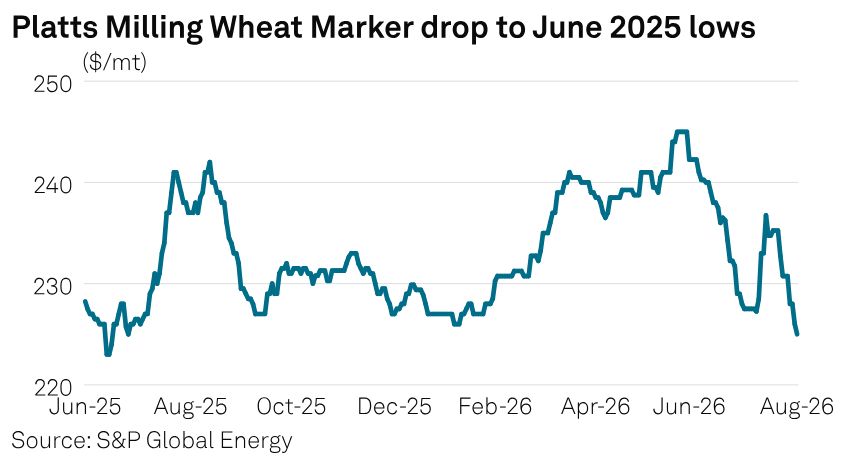
Black Sea wheat prices fall to a 13-month low despite export disruptions

Source:  S&P Global Platts
зерно доллар

The Platts Milling Wheat Marker (the benchmark price indicator for Black Sea milling wheat) for September shipments fell to $225.5/mt FOB, its lowest level since June 2025. Despite worsening security conditions in the Black Sea and ongoing export disruptions, the market remains under pressure from weak import demand.

In recent weeks, vessel calls at Ukrainian and Russian ports have dropped sharply following attacks on port infrastructure and commercial shipping. According to market participants, there are virtually no FOB buyers, while shipowners are reluctant to call at ports in Ukraine and Russia due to elevated security risks. Although some cargoes are being redirected through alternative routes, these channels are unable to compensate for the loss of traditional export flows.

The start of the new marketing season is adding further pressure to the market. Despite a large wheat harvest across the Black Sea region, exporters are unable to fully capitalize on it because of logistical constraints. As a result, sellers are lowering their price offers in an effort to attract demand.

At Ukraine’s deep-water ports of Pivdennyi, Odesa and Chornomorsk, FOB buying interest remains virtually absent. Trading activity has partially shifted to the Danube ports of Izmail and Reni, but shipments there are constrained by draft restrictions caused by low water levels on the Danube River. Meanwhile, Ukrainian 11.5% protein wheat was shipped to Egypt on coaster vessels at $265/mt, while freight costs reached $60/mt.

Conditions in key destination markets are also limiting trade. Following a record domestic wheat harvest, Turkey has little immediate need for imports except for high-protein wheat. Egypt imported only 306,000 metric tons of wheat in July, down 57.6% year on year, due to ample domestic stocks, disruptions in Black Sea supplies, and elevated freight costs.

The situation differs in Romania and Bulgaria. In July, FOB wheat from the two countries traded at an average premium of $21.76/mt over Ukrainian and Russian wheat, supported by active fulfillment of export contracts and international tenders. However, traders remain concerned about crop quality, with market participants estimating that 40–50% of the harvest may qualify only as feed wheat, limiting the availability of milling-quality supplies.

Analysts say that the combination of weak demand, elevated freight rates, and disrupted traditional export routes continues to weigh on the Black Sea wheat market. Despite heightened security risks and export disruptions, low buyer activity remains the main factor driving the Platts benchmark lower.

Tags: , , , , , , ,

Got additional questions?
We will be happy to assist!

Secret Link