

Not reform alone: How water scarcity will shape irrigation development in Ukraine
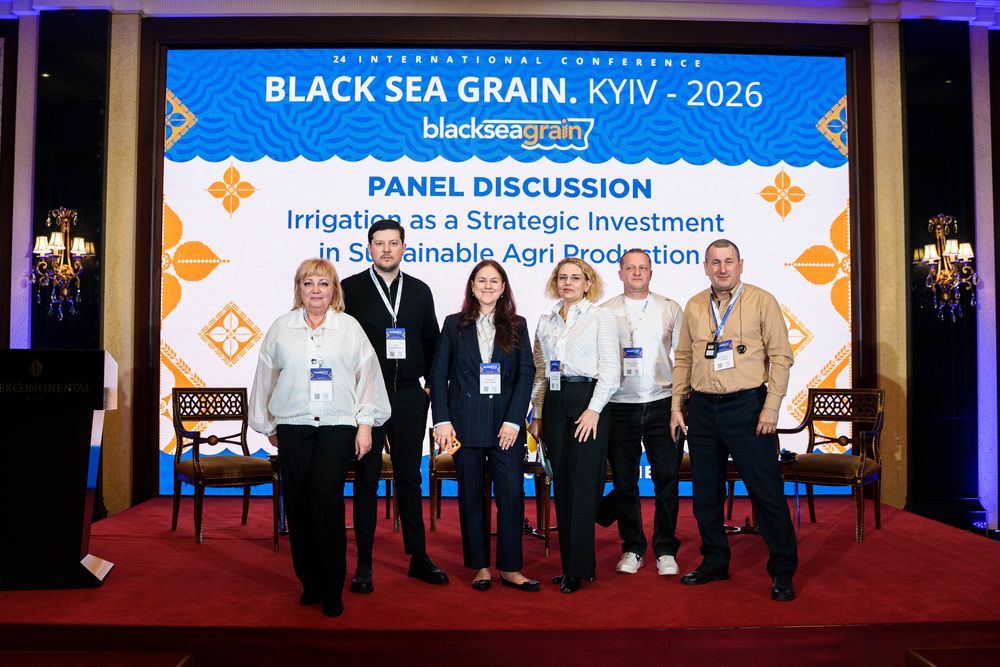
Climate change and growing water scarcity are increasingly challenging Ukraine’s agricultural sector, raising the need for expanded irrigation and improved water management. Experts estimate that out of 31 million hectares of agricultural land, about 18 million hectares already suffer from moisture deficit, while another 3 million hectares face critical water stress. This was stated during the Black Sea Grain Kyiv 2026 conference by government representatives, scientists, and market participants, who discussed the progress of the land reclamation reform and the prospects for the development of irrigation.
Against this backdrop, Ukraine is continuing its land reclamation reform. Following the adoption of draft law No. 7577, the second phase of the reform has begun, focusing on modernizing irrigation infrastructure management, developing water user organizations, and introducing a new operator-based system.
According to the Ministry of Economy, Environment and Agriculture, Ukraine has already established 77 water user organizations, 14 of which have received irrigation infrastructure assets for management. Deputy Minister Iryna Ovcharenko said the new model gradually shifts infrastructure management toward farmers themselves.
She noted that up to 80% of water delivery costs are currently driven by electricity, making energy efficiency a key priority of the reform.
Yurii Kiriak, head of the Kherson Regional Hydrometeorological Center, said climate change is already altering precipitation patterns, making rainfall more uneven and concentrated. He warned that without irrigation development, the area of arid land in northern Ukraine could increase by 30% by 2050.
He emphasized that farmers must adapt to new climate realities and strengthen water supply systems for crops.
A major challenge remains the lack of reliable water data. Ovcharenko said Ukraine effectively lacks a functioning state water cadastre, and existing water balance data does not reflect the real availability of water resources.
She added that the Ministry is currently seeking donor funding to develop a modern water cadastre and a public water resources map, which should become the foundation for irrigation expansion.
Olesia Tochytska, head of the “Lesyni Dzherela” Water User Organization, said climate change is already making irrigation necessary even in northern regions. She noted that the “Adelaida” farm restored an old irrigation system and achieved yield gains of around 10 tons per hectare in potato production.
According to her, irrigation investments typically pay back within 3.5 years, but development is still hindered by regulatory procedures, including environmental impact assessments.
Taras Kot from the State Agency for Land Reclamation Development said projects for energy-independent pumping stations based on solar power and battery storage are currently being developed to reduce the cost of water supply.
Market participants also expect significant investments in irrigation infrastructure in the coming years, which should expand irrigated areas and improve water resource efficiency in Ukraine.
Read also
Romania proposes joint NATO command to protect the Black Sea
Drought in India threatens sugar and biofuel production
Record sunseed harvest in Russia threatens to drive down prices in Kazakhstan
Corn drying costs in Ukraine could exceed the value of the grain at current prices
Oilseeds remain the only profitable segment of crop production in Russia




Got additional questions?
We will be happy to assist!
Write to us
Our manager will contact you soon