

Doubts loom over timing of Brazil’s B16 biodiesel mandate as deadline nears

Less than a month before Brazil’s latest increase in mandatory blending of biodiesel into diesel is due to come in, biofuel producers and distributors view the likelihood of hitting the deadline with skepticism.
Under the Fuel of the Future law, the biodiesel blend is scheduled to increase by one percentage point each March until it reaches 20% in 2030. However, this year’s increase from the current 15% to 16% (B16) still depends on the completion of feasibility tests “in order to guarantee safety and adequate performance.”
The other major step still required is final approval from the National Energy Policy Council (CNPE), which will regulate how the approved blend levels are implemented.
Market sentiment
Given this, diesel and biodiesel market participants suggest that the March deadline is unlikely to be met.
“The chances of a blend increase in March are very remote, and the expectation will be to see this at the beginning of the second half of the year, just as it was in 2025,” a source from a large biodiesel producer said.
In 2025, the increase of the blend from 14% to 15% was also originally scheduled for March but ended up being pushed back to August.
This year, however, there are other challenges given Brazil’s presidential elections in October, with some expecting this could mean B16 does not come in until even later. “Since biodiesel makes diesel more expensive, the government will not want an inflationary risk on the election eve,” a mid-size biodiesel buyer said.
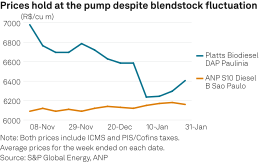
On the pricing side, diesel distributors are already facing challenges in passing on higher costs to end prices, as demand is still struggling to increase at the beginning of 2026, with the soybean harvest not yet at its peak.
“Everything indicates [the blend increase] will not happen this year,” said an analyst from a diesel distributor company. “More than 70% of biodiesel is soybean oil, which could impact its price, so it doesn’t make much sense,” the source added.
S&P Global CERA analysts Anamaria Martins, Gabriel Faleiros and Jack Larimer are “skeptical” that the government will move ahead with a higher mandate in 2026. “It’s crucial to highlight the risks associated with changes in the biodiesel blending mandate, as these decisions are driven by political factors rather than purely technical considerations,” they said in a Strategic Report released Feb. 2.
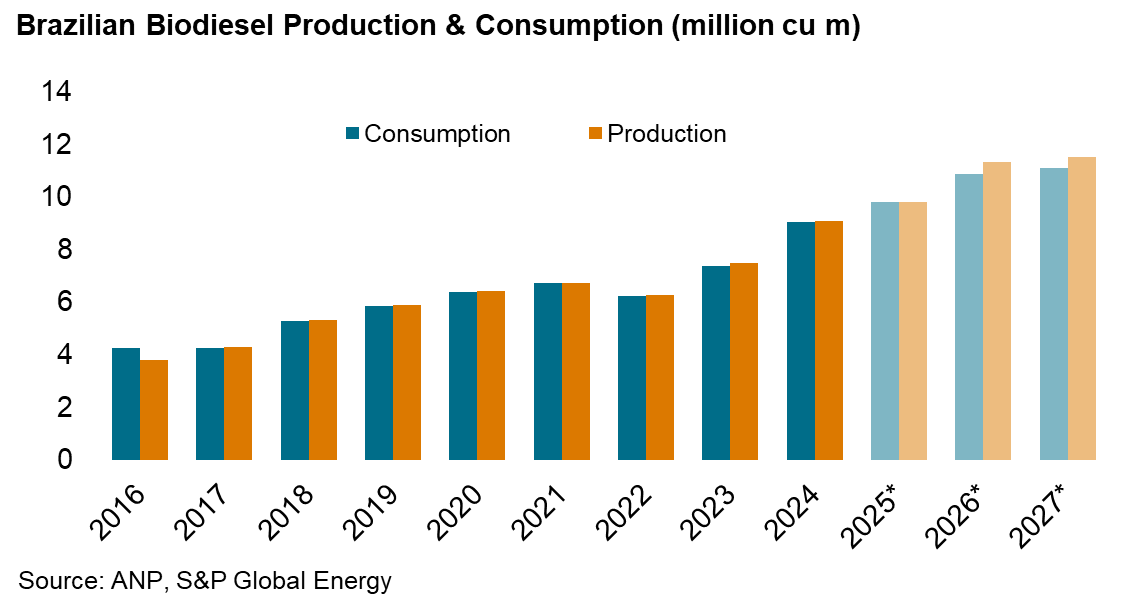
S&P Global research data is currently based on B15 being in force through the full year, given the lack of clarity or consensus for the date to increase blending from the regulation side. The data forecasts supply of over 11 million cubic meters for the year, which would be a new record high.
Official optimism
Despite the doubts in the market, officials are still optimistic that the March deadline could be met.
Federal deputy Alceu Moreira, who is president of the FPBio biodiesel caucus in Congress, said the fact that this is an election year makes it even more important for the government to prioritize implementation of a policy with environmental appeal.
He argues that previously conducted studies that prove the technical viability of blends exceeding 15% should serve as a basis for the increase in 2026.
“There is no reason not to increase the blend in March,” Moreira told Platts. “We will work hard to ensure that this schedule is met.”
Despite FPBio’s position, existing feasibility studies still require field testing and updates to comply with the current anti-pollution legislation. This necessitates further tests that will make the March deadline “highly challenging,” government officials have indicated.
Controversial timeline
At the end of 2025, biofuels producers’ association Aprobio asked Minister of Mines and Energy Alexandre Silveira for compliance with the deadline set by the Fuel of the Future law for 2026, requesting an acceleration of the feasibility tests for B16. The organization expects to hold further meetings with MME and FPBio soon.
“We need to bring this test forward, which shouldn’t even be done in the year that [the blend increase] is going to be regulated,” said Aprobio president Jerônimo Goergen told Platts. “Following the current schedule, we will have a delay.”
According to the schedule of the subcommittee responsible for the feasibility tests, reports with the conclusions on increasing the blend will be ready for validation in July-August 2026, but could be pushed back to January 2027 if additional technical and regulatory adjustments are needed.
At the moment there is no official indication that the final schedule for feasibility tests has been approved and started, suggesting that the timeline, which already did not originally allow for a March 2026 blend increase, may be even further delayed.
Biodiesel future in focus
If the deadline is not met, Aprobio foresees an immediate economic impact on producers who were counting on higher biodiesel sales. But it does not currently see a risk of disinvestment in capacity expansion or soybean crushing projects that have been announced in the country following the blend increase program.
“However, there is a risk that some projects that would be launched now may be delayed in being put into operation,” Goergen said.
More than government support, Aprobio states that biodiesel needs to be embraced by Brazil’s agribusiness as a value-added input, and sees the blend increase in the country as a fundamental part of the growth the sector expects in the coming years.
“The scenario of opening up the foreign market to biodiesel is real, and from it will come [the application of Brazilian biofuels for] HVO, SAF, and other market alternatives,” said the association’s president.
Read also
Turkey Grain Market-2026: Trade Flows, Price Dynamics & Black Sea Competition
Bulgaria Sunflower Market Enters a New Phase of Intense Competition
Mexico cuts corn production amid rising costs and low prices
Unilever may spin off its food business into a separate company
New feed mill has started operations in Romania




Got additional questions?
We will be happy to assist!
Write to us
Our manager will contact you soon