

Three tankers are charting a new route through the Strait of Hormuz, keeping away from Iran

Two oil supertankers and a LNG carrier are traveling the southern route as close to the coast of Oman as possible, Bloomberg reports, citing tracking data.
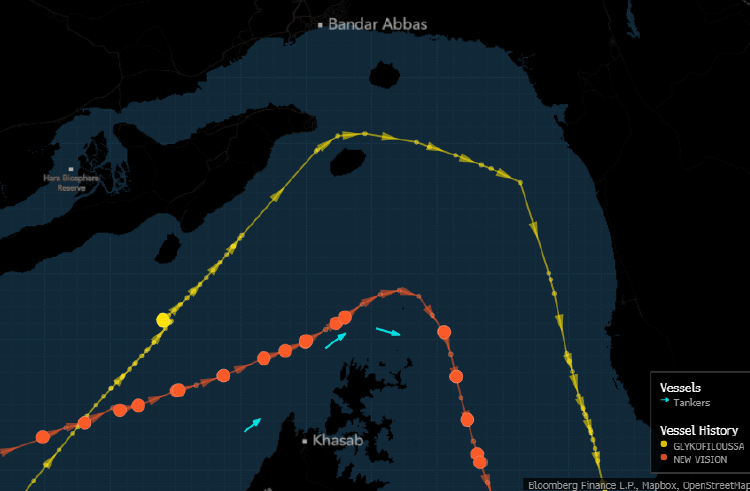
Orange is the new route along the coast of Oman, while yellow is the more northerly route between the Iranian islands of Larak and Qeshm, which has been used by most ships leaving the Persian Gulf in recent days. Source: Bloomberg
Three tankers, signaling their affiliation with Oman, entered the Strait of Hormuz, staying as close to the coast of their country as possible. This is a new route, different from the northern route through Iranian waters.
On Thursday, two oil supertankers and a liquefied natural gas carrier headed east, entering the strait. All three tankers are managed by the Oman Ship Management Company, according to the Equasis database.
While the Strait of Hormuz remains largely blocked, Iran has begun transit talks for several vessels linked to friendly countries that were using the agreed-upon northern route through its territorial waters.
On Thursday, Iran’s state-run IRNA news agency quoted Deputy Foreign Minister Kazem Gharibabadi as saying that Tehran was developing a protocol with Oman to monitor traffic through the Strait of Hormuz. Muscat’s position on these statements remained unclear.
The de facto closure of this vital waterway has sent global energy markets into a frenzy, triggering a price surge and putting growing international pressure on US President Donald Trump. Iran is also attempting to establish a toll system for passage through the Strait of Hormuz, demanding up to $2 million per vessel.
Each of the three vessels mentioned at the beginning of this article broadcast their Omani affiliation during transit. All ceased transmitting their automatic position signals at approximately 9:30 a.m. London time, as they approached the Strait of Hormuz or were just rounding the tip of Oman’s Musandam Peninsula, which juts into the strait to the north.
It is unclear whether they have completed their transit, but it typically takes several hours. Tracking vessels entering and exiting the Strait of Hormuz is hampered by intense radio interference and signal spoofing.
According to tracking data, each tanker is carrying approximately 2 million barrels of crude oil, while the LNG carrier appears to be empty. One of the tankers loaded in Saudi Arabia in late February and listed Kyaukpyu in Myanmar as its destination, from where the oil is shipped via pipeline to western China. The other tanker is carrying oil from Abu Dhabi to an unknown destination.
The route taken by the three vessels lies south of the established shipping lanes through the Strait of Hormuz (shown in orange on the map above) and far from the more northerly route between the Iranian islands of Larak and Qeshm, which has been used by most ships leaving the Persian Gulf in recent days (shown in yellow on the map).
This northern route is associated with the need to obtain Iranian permission for passage and pay the corresponding toll. However, its shallower depth and sharper turns may make it unsuitable for the largest oil tankers.
Read also
MERCOSUR Agri Markets: The Forces Reshaping Global Supply
US agricultural groups receive funding to boost exports
Happy Easter! Wishing you a blessed and peaceful holiday!
US beef returns to Australia after a 23-year hiatus
Favorable precipitation will occur in the main grain exporting countries in the ne...



Got additional questions?
We will be happy to assist!
Write to us
Our manager will contact you soon