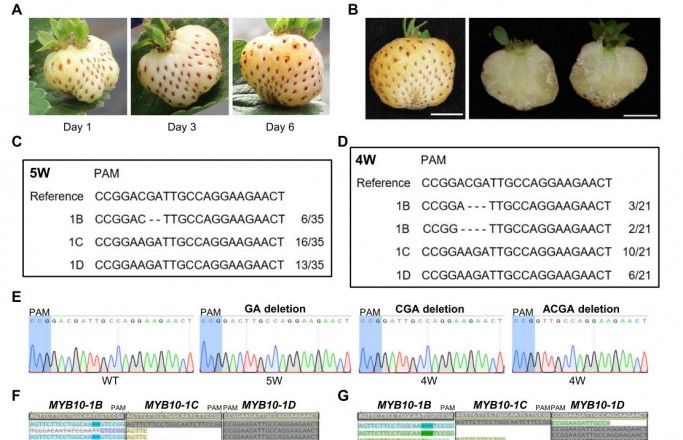
Researchers from China, South Korea, and the United States used CRISPR/Cas9 technology to transform a conventional red commercial strawberry variety, Florida Brilliance, into a stable white-fruited type. The team discovered that the rich red color of the berries is controlled by just one dominant copy of the MYB10-1B gene. Disabling this single gene completely halted anthocyanin pigment synthesis in the fruit flesh, NewsWise reports.
“This work shows that in crops with complex genetics, precision matters more than force. Instead of removing all gene copies, we demonstrated that editing one dominant gene is enough to dramatically change the plant’s appearance,” the study authors noted.
The experiment was particularly challenging because cultivated strawberry is an octoploid species, meaning it has eight sets of chromosomes. As a result, most of its genes exist in multiple copies. Previously, scientists struggled to identify which specific DNA segment to modify without affecting other plant functions. The new method enabled researchers to selectively “switch off” the target gene while leaving the strawberry seeds red, highlighting the complex regulation of color in different tissues.
Further analysis showed that after editing, the activity of key anthocyanin biosynthesis genes — including CHS, DFR, and ANS — was significantly reduced in the berries. Importantly, the plant itself remained healthy and retained all other characteristics of the elite commercial variety.
This achievement opens the door to precise control over other traits in genetically complex crops, such as flavor, nutritional value, and stress tolerance. According to the researchers, this approach could allow breeders to develop new varieties more quickly while preserving yield potential and overall quality.