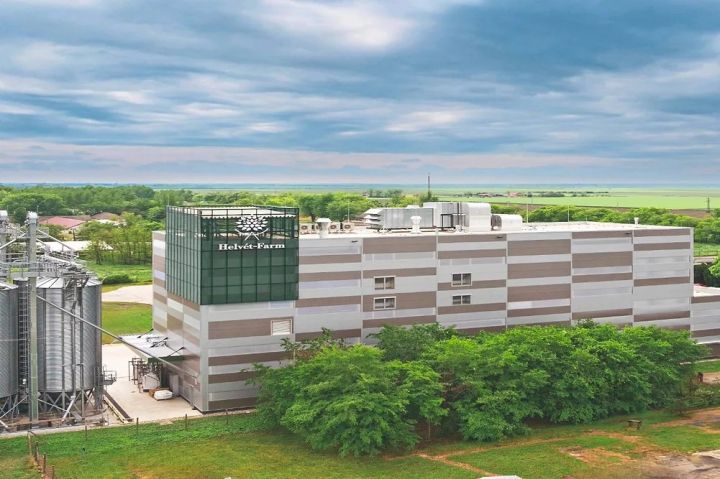
Even before the market for peas started accelerating as consumers sought alternative proteins and eco-conscious products, Helvét-Farm in southeastern Hungary knew the potential of the humble commodity, which in the past was relegated to a side dish.
While the Hungary-based company has grown peas for more than a decade, it knew promoting peas to the main attraction, particularly as an alternative to soy, would require investment in a new production process. The vision was to create an end-to-end production line, from field to table, to serve the new, growing demands of the market.
“Peas add a lot to biodiversity in the local area, and our goal is to offer them as an alternative to soy,” said Bertalan Szemerey, managing director of Helvét-Farm. “We want to provide strong competition through a controlled supply chain and efficient technology.”
Working with ProcessTrade, which oversaw the creation of a new factory, and Uzwil, Switzerland-based Bühler, which supplied the equipment, Helvét-Farm built a facility that at full capacity will process 30,000 tonnes of peas per year. It will produce pea protein concentrate, pea flour and textured vegetable protein.
The Helvét-Farm facility in Orosháza is unique in that it has both dry fractionation and extrusion technologies, producing two high-value fractions, one that is protein rich and one that is starch rich.
“Most producers either do dry fractionation or extrusion — very few do both under one roof, which makes us much more efficient,” Szemerey said, adding that it also provides for targeted use in innovative end products.
Pea demand, challenges
Helvét-Farm was created 35 years ago by a Swiss-Hungarian joint venture with 50% Swiss ownership and local Hungarian farmers, Szemerey said. His father bought the company and it has been in Hungarian ownership ever since. The family-owned business manages one of Europe’s largest certified organic businesses integrating farmers and agricultural production companies.
The company’s farms and processing facilities are located in Békes County, a region that often is overlooked by investors because of its distance from Budapest, the capital. The area is relatively flat with excellent agricultural soil and rich natural resources. It is also close to markets and land just over the border in Romania.
Although agriculture in Hungary traditionally has focused on corn, wheat and livestock, peas are gaining in popularity. Demand for pea protein in high-protein applications across the European Union is expected to grow from $460 million in 2025 to $980 million by 2035 for a compound annual growth rate of 7.9%. The Asia-Pacific region is seeing similar growth patterns.
While Western Europe has the larger portion of market value, Eastern Europe is seeing growth, led by Poland and the Czech Republic, where per capita consumption is expected to more than double in the next 10 years.
Pea processing does present some unique challenges, compared to well-established commodities such as wheat. It is a relatively new commodity for large-scale food ingredient production, particularly for human consumption, so practices are still evolving.
“Compared to wheat, peas show higher variability in quality depending on variety, growing conditions and harvest year,” said Vivienne Angeli, head of business segment pulses at Bühler. “Protein content, starch composition and functional properties can vary significantly, which makes consistent processing more complex.”
Helvét-Farm addresses these challenges through rigorous raw material selection, advanced cleaning and dehulling processes and tight process control throughout fractionation.
“Food safety, traceability and gentle processing are especially important to preserve functional protein properties while minimizing losses,” Angeli said. “By combining modern processing technology with close collaboration with local farmers, these challenges can be effectively managed.”
 The PolyTwin twin-screw extruder enables the production of specialized ingredients for the food, pet food and feed sectors.
| Credit: ©BÜHLER
Processing capabilities
Construction on the facility started in September 2023 and was completed a year later, with the finer details smoothed out over the winter. At full capacity, the facility will process 30,000 tonnes per year, which requires farming 9,000 to 10,000 hectares.
The company follows a 70/70 rule — sourcing 70% of its raw materials from within a 70-kilometer radius, Szemerey said. Helvét-Farm focuses on traditional methods of farming, placing more emphasis on crop rotation, he said.
The most successful players in the plant-based protein market not only produce high-quality protein ingredients but also understand the requirements of the end markets, Angeli said. For this reason, Helvét-Farm decided to integrate its value chain one step further by combining dry fractionation and extrusion at the same facility, which allows for targeted use in end products.
Bühler’s solutions cover the entire process, starting with cleaning, classifying and dehulling the raw product, she said. Special emphasis is placed on pulse cleaning equipment, where high quality and food safety are critical, Angeli said.
“Advanced cleaning removes foreign material effectively, while dehulling improves hygiene, removes indigestible fiber and enhances protein purity, all while minimizing yield losses,” she said.
The streams are then split into a protein-rich and starch-rich fraction. The twin-screw extruder PolyTwin, extrudates the protein-rich stream into a fibrous product for pet food and meat alternatives.
“The starch stream can be used as a higher-protein pea flour, which can be applied in a wide range of food products to not only add protein, but also fiber, and nutrients for snacks, pasta and baked goods, to name but a few,” Angeli said.
Balázs Domján, factory manager, said he gets great satisfaction out of getting the most out of every pea.
“Once it’s broken down into starch, protein and husk, pea is such a rewarding plant, with so many uses,” he said. “It’s like a blank canvas. It’s good for food, feed and pet food — as well as plant-based proteins.”
The twin-screw extruder is well suited due to its versatility, and allows precise control over shear, temperature, and moisture, enabling the production of a wide range of textured vegetable proteins with different structures and functionalities.
The facility requires a core operations team of about six people per shift. Szemerey was pleasantly surprised by how smoothly the recruitment process went.
“I had been worried about the challenge of attracting people to Orosháza,” he said. “But since this is a greenfield investment, people can see that we are prioritizing quality. Once they understand this, they’re much more open to explore the possibilities we can offer here.”
End users
The facility’s setup allows Helvét-Farm to conduct in-house research and development not only on protein ingredients but also on its performance in real food applications. By producing both functional protein concentrates and texturized raw materials, they can directly translate ingredient functionality into customer-ready solutions, Angeli said. The main benefit is speed and flexibility, new product concepts can be developed, tested, and optimized much faster.
“The challenge lies in operating and coordinating two advanced processing technologies under one roof, each with its own quality and process requirements,” she said. “However, the integrated approach creates significant added value for customers and positions the facility as more than just an ingredient supplier.”
The end users are diverse and range from small, innovative startups to large multinational companies. Applications include food products such as meat alternatives, dairy alternatives, bakery items, snacks, and convenience foods, as well as feed applications where high-quality plant proteins are required.
Szemerey said when Helvét-Farm started the process, he didn’t think the Hungarian market had great potential, hoping for at least 5% of its customers in the region.
“But in the past six to eight months, we’ve been very pleasantly surprised that there are many innovative companies interested in what we will produce,” he said. “Now I can envision up to 30%, 40%, even 50% of our customers being within this immediate area, meaning Serbia, Romania, Croatia and Austria. We can get to these places quite quickly.”
End products also are positioned for the global market, including established markets in Europe and North America, as well as emerging markets where demand for sustainable protein sources is rapidly increasing, Angeli said.
“Helvét-Farm is actively exploring both existing and new application areas, developing products that meet not only today’s needs but also those of tomorrow, often in close collaboration with its customer base,” she said.
While Helvét-Farm and Bühler have worked together in the past on smaller projects mainly involving machines for grain cleaning applications, this is their first large-scale project. The companies were a perfect fit since they both strive for maximum control of the value chain, said Martin Krenn, sales manager Central Eastern Europe at Bühler.
“Helvét-Farm has been such an interesting partner because they can cover the whole chain from farm to fork,” he said. “It is quite rare to have these capabilities within one company.”