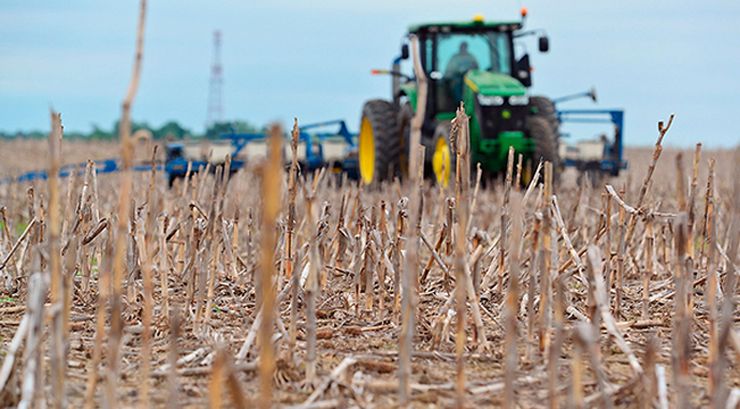
In arid regions of the United States, efforts are underway to conserve soil moisture. Farmers primarily use no-till technology and retain more crop residues on fields. This helps cool the soil and reduces moisture evaporation.
This was explained by Dr. Mark Licht, Doctor of Agricultural Sciences and practicing agronomy consultant, during the online training session “The Formula for Successful Planting: Temperature, Moisture, Depth.”
He noted that each tillage operation reduces soil moisture by half an inch, while every pass of machinery causes evaporation of about 1.3 cm of soil moisture. When irrigation is used but water resources are limited, farmers can irrigate before planting and immediately after. Moistening the soil to a depth of 1.25 cm is sufficient for seeds to germinate and emerge. Once seedlings have emerged, they can rely on existing soil moisture.
Corn water uptake rates change as the crop approaches the pollination stage, when it absorbs more moisture from the soil. During the season, soil can be irrigated at a rate of up to 4 cm per day, but when corn reaches pollination and early grain-filling stages, water supply should be increased to 8 cm per day. For soybeans, soil moisture affects node formation, and inoculants can be beneficial on drought-prone soils. Lack of moisture and dry conditions prevent the formation of key nodes on soybean stems.
In some U.S. regions, farmers plant early-maturing corn hybrids or soybean varieties. They expect that corn pollination and the grain-filling period will occur when sufficient soil moisture is available and temperatures are optimal, avoiding crop stress.