

Land reclamation as a key to the development of Ukraine’s agricultural sector
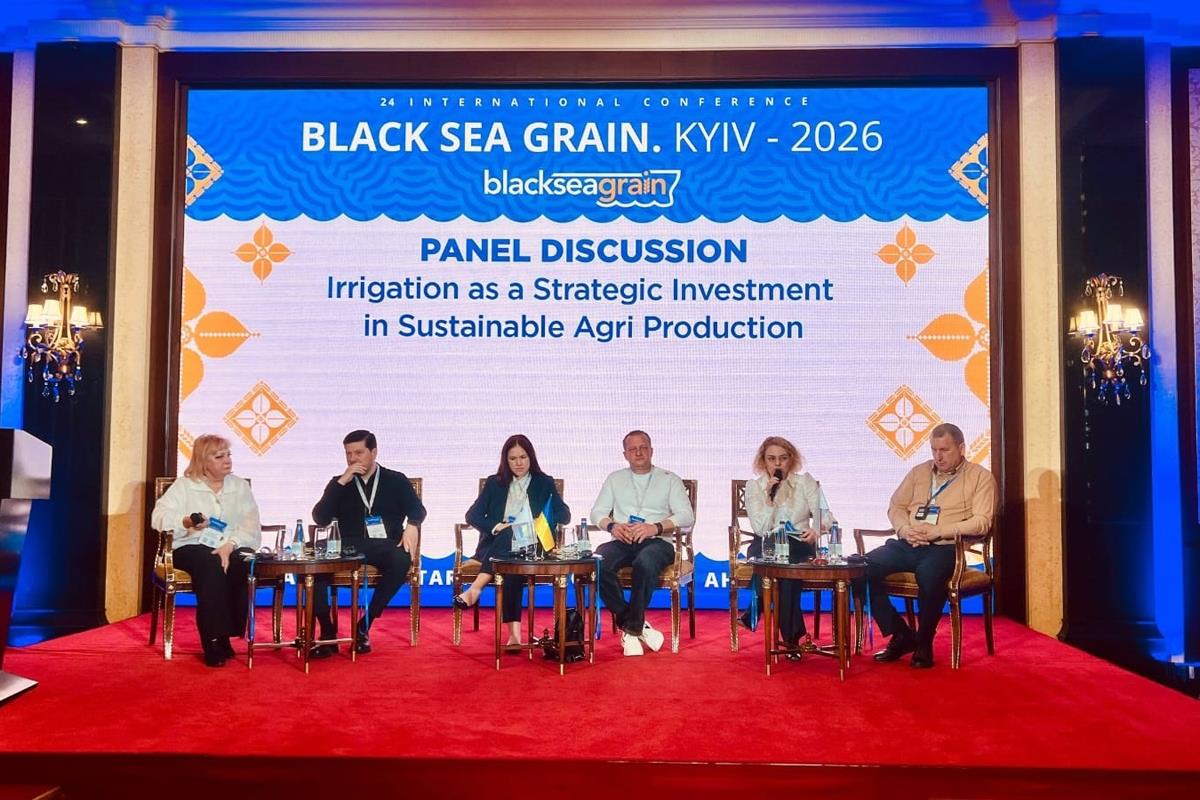
Climate change, water scarcity, and increasing risks to agricultural production are forcing Ukraine to rethink its approach to water resource management. Land reclamation is no longer just a tool for increasing yields — it is becoming a strategic condition for the stability of the agricultural sector. At the same time, the existing system requires deep transformation: from infrastructure upgrades to the creation of transparent governance mechanisms and a clear understanding of available water resources.
Against this backdrop, the reform of land reclamation and irrigation development became key topics during a panel discussion at BLACK SEA GRAIN. KYIV – 2026. The event was attended by Deputy Minister of Economy, Environment and Agriculture of Ukraine Iryna Ovcharenko. Representatives of government authorities, agribusiness, industry associations, experts and traders, banking and investment institutions, international organizations, and the expert community also joined the discussion.
The Deputy Minister outlined the key steps being taken by the state to implement land reclamation reform. These include developing a modern legislative framework, establishing water user organizations, and introducing a new governance model through operators of reclamation systems.
According to her, a systemic transformation of the water sector has been ongoing since 2021. In particular, the governance model is changing: functions are being redistributed among state bodies, new institutions are being created, and farmers are increasingly involved in managing reclamation infrastructure.
Currently, 77 water user organizations have already been established in Ukraine, 14 of which have received reclamation assets for use. This has formed the basis of a new model in which water users themselves play a key role.
“We are effectively carrying out a full transformation of the land reclamation system by involving farmers in infrastructure management. The state has created the legislative foundation and opened new opportunities, but from here on, it is the responsibility and initiative of the water users themselves,” said Iryna Ovcharenko.
At the same time, she noted that one of the key challenges remains water resources. Ukraine has a State Water Cadastre, and water management balances are being developed, but they do not provide a complete picture of the actual available water resources and, consequently, the potential for irrigation development.
Therefore, one of the priorities for developing the water sector is the creation of a modern water cadastre and a public water resources map, which will make it possible to clearly identify where there is real potential for irrigation development, rather than just existing demand from farmers.
Special attention during the event was given to the search for new engineering solutions and infrastructure modernization. According to the Deputy Minister, the sector needs “technical innovations” — from updating irrigation approaches to finding alternative solutions for full water supply to users. Another challenge is the energy intensity of irrigation: currently, up to 80% of water costs are driven by electricity. At the same time, the transition to energy-independent solutions is seen as a matter of time and technological progress.
The financial aspect of the reform is also evolving. In particular, the law on operators of reclamation systems opens opportunities for consolidating water users into larger structures, attracting investment into the sector, and establishing economically justified water pricing.
The BLACK SEA GRAIN. KYIV – 2026 became an important platform for dialogue between the state and business on land reclamation reform and its further development.
Read also
Ukrainian farmers may reduce pea planting due to low prices and high logistics costs
Ukrainian farmers expand commercial pumpkin production
US soybean crush falls to 13-month low
Global wheat supply deficit triples, increasing upside price risks
India to involve 40,000 farmers in mustard yield improvement program




Got additional questions?
We will be happy to assist!
Write to us
Our manager will contact you soon