

EU may shut poultry market to Ukraine’s main competitor
Brazil could be banned from exporting meat products to the European Union starting in September 2026 unless it proves compliance with the bloc’s antimicrobial resistance rules, Euractiv reported, citing a European Commission spokesperson.
On Tuesday, the European Commission published an updated list of countries that confirmed compliance with EU restrictions on the use of antimicrobial substances in livestock production. Under EU rules, such substances cannot be used to stimulate growth or increase animal productivity.
“The European Commission confirms that Brazil is not included on this list, meaning it will no longer be allowed to export products to the EU — including live animals and processed products such as beef, horse meat, poultry, eggs, aquaculture products, honey, and casings — starting from September 3, 2026,” said European Commission health spokesperson Eva Hrncirova.
She added that Brazil must ensure compliance with EU standards “throughout the entire life cycle of animals.”
The decision comes just days after the preliminary entry into force of the EU-Mercosur trade agreement on May 1, covering Argentina, Brazil, Paraguay, and Uruguay, which includes tariff reductions for products such as beef and poultry. Brazil is currently the only Mercosur country absent from the Commission’s approved list.
According to Hrncirova, the European Commission has been “closely engaging with Brazilian authorities” on the issue and will continue working toward compliance with EU standards.
“Once compliance is confirmed, the EU may authorize or resume exports,” she added.
Meanwhile, Brazil’s mission to the EU described the decision as “unexpected” and said there had been no recent communication from the Directorate-General for Health and Food Safety (DG SANTE), despite repeated Brazilian attempts to initiate dialogue.
The European Commission stressed that these rules are part of the “One Health” strategy aimed at combating antimicrobial resistance, which EU producers have been required to follow since 2022.
According to the EU’s food and agriculture vision through 2025, the same principles should also apply to imports.
The Commission describes antimicrobial resistance as “one of the greatest threats to public health of our time,” emphasizing that controlling the use of such substances is essential to protecting EU citizens.
Since 2024, the EU has maintained a preliminary list of non-EU countries that meet these requirements and are allowed to export products to the bloc. The EU regularly updates this list by adding or removing countries. The latest version was approved by all member states during Tuesday’s meeting.
Why This Matters for Ukraine
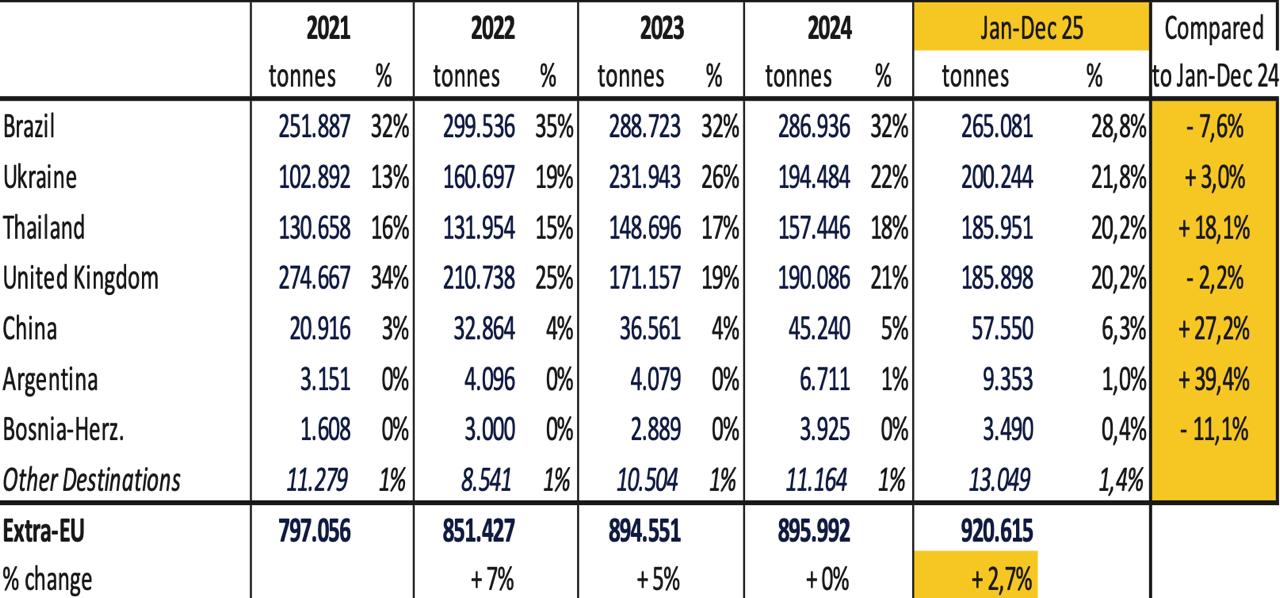
Brazil is Ukraine’s main competitor in the European poultry market. In April 2026, Eurostat published a report showing that EU poultry imports from third countries increased by 3% in volume and by 18% in value in 2025 compared to 2024.
The largest increases came from Thailand, Ukraine, and China, while imports from Brazil and the United Kingdom declined.
Imports from Brazil, Ukraine, the UK, and Thailand account for nearly 91% of all EU poultry imports.
In carcass weight equivalent, the figures are as follows:
• Brazil — 265,000 tons (28.8%)
• Ukraine — 200,200 tons (21.8%)
• Thailand — 186,000 tons (20.2%)
• United Kingdom — 186,000 tons
Read also
Latvia plans 300% tariff on grain from Russia and Belarus
Join the 4S Business Summit Rotterdam 2026
Ukraine prepares beef for export to the UK
Certified sustainable palm oil already accounts for 20% of the global market
Grain is the second most sensitive issue in Poland after historical disputes




Got additional questions?
We will be happy to assist!
Write to us
Our manager will contact you soon