

Low meal prices pose risks to soybean crush margins in South America

Low soybean meal prices have reduced crushing margins in South America, creating uncertainties about the processing pace of the oilseed in two of the world’s leading suppliers, Argentina and Brazil.
On Aug. 22, Platts, part of S&P Global Commodity Insights, assessed the Brazil Soybean Crush Spread, a theoretical crushing margin involving the prices of soybeans, meal, and oil at the port of Paranaguá, at $21.79/mt, a decline of more than 50% compared to the previous year.
Meanwhile, in Argentina, the FOB crush margin was last seen at zero, sharply down from $51/mt by this time in 2024, according to Commodity Insights’ calculations.
“Weaker soybean meal prices combined with higher-than-normal South American soybean basis due to additional Chinese demand have led to lower crush margins in Brazil and Argentina,” Commodity Insights’ analysts said in the latest Weekly Soybean Complex Update report, released on Aug. 22.
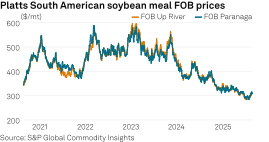
Indeed, spot export prices for soybean meal in both South American origins have been hovering around $300-$310/mt, compared to approximately $370/mt at the same time in 2024, according to Platts. Prices even dipped below $300/mt at times this year, marking multi-year lows.
In the case of soybeans, Platts’ SOYBEX FOB Santos was assessed at $449.58/mt on Aug. 22, a 12% increase year over year. In 2025 alone, this price has already risen by 17.5%.
Brazil is the world’s largest producer and exporter of soybeans, while Argentina holds the third position. Both are also the main global suppliers of the oilseed’s byproducts, namely meal and oil.
Interestingly, the tight margin scenario for South American industries is occurring at a time of strong demand for soybean oil. In Argentina, this is for export, while in Brazil, the biodiesel industry has intensified purchases to meet the mandatory 15% blend with diesel, effective this month.
In July, Argentina crushed 3.80 million mt of soybeans, according to official data. This volume fell short of expectations.
“Despite robust demand for soybean oil exports, tight oil stocks, reduced export taxes, and an ample supply of soybeans for industries, the crush pace has not met expectations,” said the Commodity Insights analysts, emphasizing that “this shortfall can be attributed to eroded crush margins, as soybean meal prices have hit their lowest level in several years.”
As a result, the analysts have cut the soybean crushing forecast in Argentina for both the 2024-25 (April-March) and 2025-26 marketing years by 1 million mt each, to 43 million and 44 million mt, respectively.
In Brazil, high soybean oil prices still provide some relief to soybean processors, who are expected to crush a record 58 million mt in the current 2024-25 cycle (January-December).
“As we move forward, these eroded crush margins present a downside risk to total crush volumes. To meet the biodiesel blend mandate, the industry might shift some oil volumes from exports to the domestic market instead of ramping up the crush pace,” warned the Commodity Insights analysts.
Currently, spot prices for Brazilian soybean oil FOB Paranaguá are around $1,150/mt, compared to $915/mt a year ago, according to Platts.
Further development of the grain and oilseed markets of Ukraine and the Black Sea region will be in the spotlight of the BLACK SEA GRAIN. KYIV conference, taking place on April 22–23 in Kyiv. The event will focus on strategic directions for the agricultural sector through 2030, including investments, energy independence, processing, and exports of high-value products.
Join strategic discussions and networking with industry leaders to gain актуальна insights, discover new business opportunities, and build partnerships with key market players.
Read also
Trump warns Iran over shipping fees in the Strait of Hormuz
Brazil’s grain sector continues structural transformation
Black Sea & Danube: Crop and Export Forecast
Iran ceasefire shifts soybean market focus to Brazil and rising global supply
Turkey expects a better wheat harvest, but the agricultural sector faces new chall...




Got additional questions?
We will be happy to assist!
Write to us
Our manager will contact you soon