

Logistical constraints shift EU corn import dynamics, Ukraine loses share

As the marketing year (September-August) for corn advances, trade dynamics in the EU, the world’s second-largest corn importer, have shifted due to geopolitical factors, price sensitivity, and demand.
According to data from S&P Global Market Intelligence’s Global Trade Analytics Suite, EU corn imports totaled 18.79 million mt in MY 2024-25, down from 19.83 million mt in 2023-24. GTAS projects imports at 21 million mt for MY 2025-26.
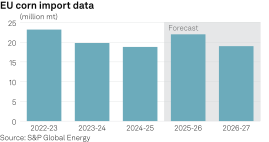
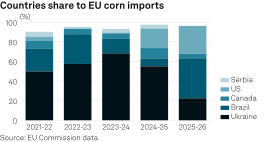
Ukraine was the leading supplier to the EU, followed by Brazil. However, in EU’s MY 2025-26 (July-June), a larger share of import volumes shifted toward Brazil, largely due to logistical constraints linked to the war in Ukraine, according to European Commission data.
Within the EU, Ukraine has remained the dominant origin on a five-year average basis, supplying around 9.7 million mt annually, or 53.5% of total EU corn imports. Brazil accounted for 22.5% over the same period, followed by Canada, the US, and Serbia. In MY 2025-26 (July-June), Brazil’s share increased to 40%, followed by the US at 28.3% and Ukraine at 22.4%.
Market participants reported delays in receiving contracted Ukrainian corn, prompting buyers to source alternative origins, including Brazil and the US.
“Logistics issues in Ukraine are creating challenges for buyers,” a Netherlands-based trader said, adding that delays in fulfilling existing contracts had affected procurement flows. Another trader said the logistical disruptions were pushing buyers to “choose other origins.”
Market participants also pointed to the EU-Mercosur trade framework as a factor influencing origin selection, alongside existing logistical constraints. “With the trade deal, nothing can be predicted,” a market expert said.
In the EU, Spain, the Netherlands, and Italy are the main corn importers. According to European Commission data, Spain imported 7.2 million mt of corn in MY 2024-25 (July-June), down from 7.6 million mt in 2023-24. The Netherlands imported 3.3 million mt in MY 2024-25, up from 2.6 million mt in 2023-24, while Italy imported 2.8 million mt in MY 2024-25, up from 2.1 million mt in 2023-24.
Shift in Ukrainian corn flows
According to GTAS, from January to September 2025, 13% of Ukraine’s corn exports went to Italy and 10% to Spain (down from 19% in 2024), while 9% went to the Netherlands.
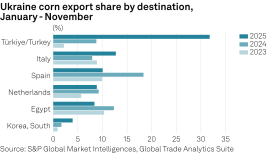
Spain switched sourcing to the US, which offered more competitive prices than the Black Sea region last year. As a price-sensitive market, Spain benefited from lower US corn prices, aided by US trade tariffs and reduced US exports to China. Meanwhile, Ukrainian corn was relatively expensive due to strong demand from Turkey, contributing to Spain losing its position as the top importer. An importer in Spain said, “Ukrainian corn [is] totally out of the game for Spain.”
However, as the Ukrainian season advances, traders expect stronger demand from Europe. A Ukrainian seller said, “50% of Ukraine’s corn exports would be to the EU.” Another seller said, “I guess Turkey, Italy, and Egypt will be the major destinations for Ukrainian corn.” The seller added, “It seems we are losing Spain to US corn now, but the second half of the season might be different depending on Ukraine’s export pace.”
Traders expect Italy and the Netherlands to remain dependent on Ukraine for corn imports, while demand from Spain will depend on the trade relationship with the US. A few Ukrainian cargoes were traded to Spain early in 2026 due to trade uncertainties for importers from the US. A Ukrainian seller said, “Spain might turn to Ukrainian corn because Trump might put their trade relations under threat.”
Feed demand
The feed industry accounts for the largest share of corn use in the EU, alongside ethanol production and food applications. Corn remains a key feed ingredient in Europe’s protein production sector. Buyers noted that animal disease outbreaks, including African swine fever and avian influenza, have affected feed demand. “These disease outbreaks decrease protein demand, directly affecting the feed market, which also impacts corn,” a Spain-based buyer said.
Participants also reported feed formulation adjustments, with substitution between corn and feed wheat when relative price competitiveness shifts. “When feed wheat becomes more competitive, demand shifts,” the same Spain-based trader said.
A similar trend was observed in Italy. An importer in Italy said that feed wheat and corn are currently at parity, and that corn for April-May loading is more expensive than wheat, which could result in increased wheat use in feed rations.
Platts, part of S&P Global Energy, assessed European animal feed corn ex-works Tarragona at Eur213/mt for loading over Feb. 3-March 5. Ukrainian corn was assessed at $223/mt FOB POC for March 3-17 loading, and Brazilian corn at $210.81/mt FOB Santos for August loading on Feb. 3.
Read also
Food, Fuel, Future: How Will Ukraine Scale Processing?
Poland wants to build new rapeseed processing plants, although it already has exce...
Middle East crisis sees global urea prices established above $700pt fob
Trump administration replaces USAID with new agency
Rice and corn prices soar in North Korea




Got additional questions?
We will be happy to assist!
Write to us
Our manager will contact you soon