

Brazil gains increased EU poultry market access via EU-Mercosur agreement
Following over 25 years of negotiations, the EU-Mercosur partnership agreement (EMPA) and the interim trade agreement (iTA) were signed on Jan. 17 in Asunción, Paraguay. The agreements will eliminate or reduce export and import tariffs for a wide range of goods, with poultry specifically highlighted among the agricultural commodities set to benefit from improved market access.
Currently, Brazil exports poultry to the EU under a quota system, which permits a set volume of tariff-free exports, while shipments exceeding this limit incur additional tariffs. Under the new agreement, an annual tariff-exempt export quota of 180,000 metric tons for both bone-in and boneless poultry will be introduced and phased in over six years.
According to the Council of the EU, the iTA will take effect before the EMPA is approved by the European Parliament and the legislatures of the Mercosur countries. However, the iTA still needs to be ratified by the EU, which is expected to happen in the first half of 2026. Brazil’s Ministry of Agriculture said the agreements were signed by the foreign ministers of the Mercosur countries and the EU commissioner for trade and economic security.
Brazil poultry exports to EU exceed current quotas
In 2025, EU countries accounted for 4.3% of Brazil’s poultry exports, totaling 231,338 mt, according to Brazil’s Foreign Trade Agency, SECEX. These exports include both fresh and processed chicken meat, with most shipments consisting of boneless chicken breast. The EU is also a key buyer of salted and cooked chicken breast, which are high-value products for Brazilian exporters.
In 2025, the EU suspended imports of Brazilian poultry for about four months following a bird flu outbreak in Brazil. Despite this ban, the EU still accounted for 8.5% of Brazil’s total boneless chicken breast exports and 15% of its processed and semi-processed chicken meat exports.
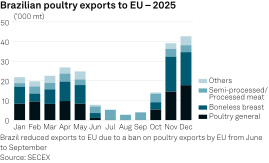
Researchers from Brazil’s Center for Advanced Studies on Applied Economics said that in 2025, the volume of poultry exports to the EU was more than 10 times the quota of about 15,000 mt/y at the time, and that the EU-Mercosur Partnership Agreement is set to increase Brazilian poultry exports to the EU.
Exporters celebrate; European producers raise concerns
The Brazilian Association of Animal Protein (ABPA) celebrated the conclusion of the agreement. The association said that while the deal does not alter the current poultry export quota system between Brazil and the EU, it will increase the annual quota.
ABPA emphasized that the quotas set by the agreement apply to all Mercosur countries, not just Brazil, and that coordination among bloc members is required to determine allocation criteria.
In contrast, the Association of Poultry Processors and Poultry Trade in the EU criticized the EU-Mercosur agreement, warning it will have serious and lasting effects on Europe’s poultry sector, especially when combined with other trade agreements.
The association said more than 25% of the chicken breast consumed in the EU comes from third countries, and with the new agreement, total imports could reach 9% of all EU poultry consumption, putting additional pressure on EU producers.
Read also
BLACK SEA GRAIN. KYIV: Join with a SMART rate by March 31!
Ethiopia launches national plan to revive sorghum production
Romania Rapeseed Market Enters Phase of High Yield Potential and Price Adjustment
Wheat in the US could become profitable again thanks to GM seeds
Potato prices in Europe have fallen below zero due to a surplus crop




Got additional questions?
We will be happy to assist!
Write to us
Our manager will contact you soon