

Global beef supplies are shrinking

Rosario Livestock Market (Rosgan) analyzed global production and trade forecasts prepared by Rabobank, an organization considered the global benchmark in this field.
According to Rosgan’s report, based on data from the international organization, both Brazil and Argentina may be entering a cycle of declining beef production, although this does not necessarily mean a decline in exports.
According to an analysis presented in the Rosario Livestock Market (Rosgan) report based on global production and trade forecasts prepared by Rabobank, an organization specializing in the agri-food sector and considered the global authority in this field, global beef production is breaking its growth cycle, and supply is declining.
In its quarterly global beef production report (Q4 2025), the bank forecasts that global beef production will continue to decline during the next cycle.
Following a projected annual decline of 0.8% this year, the first after five years of growth, Rabobank predicts the contraction will deepen in 2026, with global production falling by 3% annually.
Before the release of the USDA forecasts, these initial data had a strong impact on the sector, not so much because of the expected decline, but because of its scale.
However, surprisingly, at the time of this report’s publication, after weeks of delays due to temporary closures of official services, the USDA finally released its forecasts for global meat production and trade for the next cycle, confirming the expected decline.
This revision is particularly relevant as it marks the end of a long period of growth in global production recorded over the past five years.
While the USDA’s projected rate of decline is significantly lower than Rabobank’s (1% per year), its forecasts also imply a decline in global production of nearly one million tonnes, bringing its estimate to 61 million tonnes globally.
At the same time, the agency revised its current-cycle production forecast upward, increasing it by nearly 400,000 tonnes compared to its previous estimate to 61.95 million tonnes per year after making important adjustments for Brazil and Australia.
Notably, Argentina is among the group of countries that will end 2025 with a relative increase in production of approximately 1.25%.
However, according to official data, Argentina slaughtered a total of 12.4 million head of cattle between January and November, a 2% decrease from 2024, yielding 2,880 tonnes of meat, a 0.5% decrease compared to the same period last year.
“With just one month remaining in the annual cycle, Argentina is likely to slaughter approximately 13.6 million head of cattle by the end of 2025, with projected production at approximately 3,150 tonnes, down just 1% from 2024, thanks to a significant improvement in average carcass weights,” Rosgan’s report states.
Of this total, exports are estimated to be between 880,000 and 900,000 equivalent tonnes, down approximately 5% from a year ago, compared to the North American agency’s forecast of a 10% decline.
“Slaughter volumes are likely to remain limited in the next cycle and may even decline further than this year if the trend toward maintaining livestock numbers continues.”
“However, even if slaughter levels remain the same, it is possible that overall meat production will increase slightly due to the slaughter of larger animals, a trend that has already begun to be observed this year,” the report states.
However, given strong external demand, it is likely that, regardless of production growth, shipment volumes will increase moderately in 2026, which will negatively impact domestic consumption.
“In fact, the USDA projects Argentina’s export surplus to increase by 6.5% annually, to 810,000 equivalent tons, which, according to our data, would imply exports of close to 960,000 tons,” the Rosario-based organization stated.
Something similar could happen in Brazil, the world’s leading beef producer and a strong competitor to Argentina as a regional supplier.
Unlike Argentina, however, Brazil is expected to achieve record export figures this year. According to official data, the country exported a total of 2.8 million tons of beef by the end of November, a 19% increase from 2014.
Recently, Brazil’s national supply company (CONAB) forecast a significant decline in beef production by 2026, estimating it at approximately 10.89 million tons, a 4.6% decrease compared to the previous year. This decline is primarily due to the increased share of cattle destined for herd rebuilding.
However, even accounting for this decline, CONAB’s report claims that beef exports could remain high, reaching volumes close to 4.3 million tons, which would be a new historical record for the country.
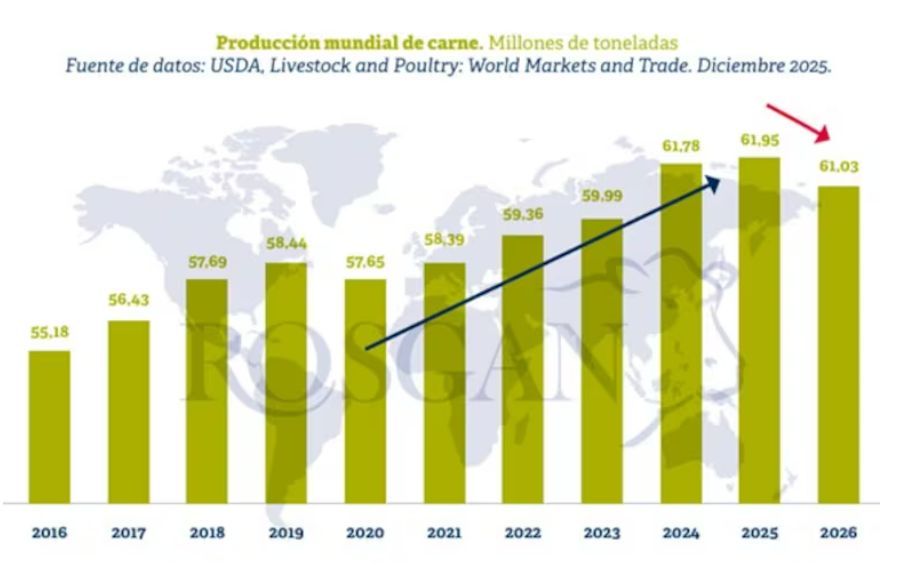
However, there is currently no complete agreement with the forecasts recently published by the USDA. While both organizations agree on a projected annual production decline of 5%—to 11.7 million tons, primarily due to reduced cattle slaughter—their estimates for exports differ.
While CONAB expects a new record, the USDA forecasts a slight decline in external shipments from 4.25 to 4 million tons per year as a result of reduced available supply.
However, the same report notes that the organization had to adjust its 2025 export forecast by at least 500,000 tons, so it would not be surprising to suspect a possible underestimation of the responsiveness of this global trade giant.
In short, both Brazil and Argentina may enter a cycle of declining production, although this does not necessarily mean a decline in exports.
“In a context of strong international demand and tight supply, both countries will certainly seek to balance the allocation between domestic demand and exports in order to take advantage of the current favorable situation in the global meat market and advance the recovery of their respective livestock sectors,” the report concludes.
Read also
Argentina’s grain exports surge amid record harvest and global volatility
Food, Fuel, Future: How Will Ukraine Scale Processing?
Iran allows limited passage of grain vessels through the Strait of Hormuz
Ukraine announces first forwards for new crop corn in ports and at the border
World on the brink of a global LNG shortage: gas supplies from the Persian Gulf ne...




Got additional questions?
We will be happy to assist!
Write to us
Our manager will contact you soon